Positive Writer
  • Inspiration
  • Writer’s Doubt
  • Free eBook Good Enough
  • Contact
    • Guest Post Guidelines for Positive Writer
  • Resources
  • Archives
  • About
    • The Wee-Jees Book Launch Team
      • Picture Files for the Book The Wee-Jees
    • Privacy Policy
    • Free Book
  • Inspiration
  • Writer’s Doubt
  • Free eBook Good Enough
  • Contact
    • Guest Post Guidelines for Positive Writer
  • Resources
  • Archives
  • About
    • The Wee-Jees Book Launch Team
      • Picture Files for the Book The Wee-Jees
    • Privacy Policy
    • Free Book

Positive Writer

Category:

Uncategorized

An Editor’s Guide to Why You Don’t Suck

An Editor’s Guide to Why You Don’t Suck

written by Bryan Hutchinson

Writing is hard. Revising is hard too—in fact, often, it’s even harder. And both are so much more difficult and challenging than you ever imagine the first time you sit down to write a novel, or a short story, or a memoir. As you work and work and work in pursuit of perfection, and as you deal with feedback from beta readers and book editors like me, encountering again and again everything you’re doing wrong, you can’t keep the thought from squirming its way into your head:

Does this suck? Do I suck?

Note: This is a guest post by Developmental editor Harrison Demchick. Harrison came up in the world of small press publishing, working along the way on more than eighty published novels and memoirs. He’s also the author of 2012 literary horror novel “The Listeners” and short stories including “Tailgating” (Tales to Terrify, 2020) and “The Yesterday House” (Aurealis, 2020), and as a screenwriter his first film Ape Canyon was released in April 2021. Harrison is currently accepting new clients in fiction and memoir at the Writer’s Ally

Speaking as an editor who has worked on many, many novels and memoirs over the last fifteen years: probably not. Or at least no more than everyone else.

But whenever it should happen that you find yourself convinced of exactly the opposite, here are some important ideas to keep in mind.

First Drafts are Never Final Drafts

Ask any editor if an author has ever sent them a perfect first draft and you’ll probably get the same answer: No. Never. Not even close.

I’ve certainly never seen one. I sure as heck haven’t written one. And the very simple reason for that is that you discover the story you want to tell through the process of writing it. This is true whether you outline and plan carefully and revise as you go or fly by the seat of your pants toward a completed draft, because under any circumstances things change during the writing. It’s so hard to see the forest while you’re still planting the trees.

It’s true as well that every next draft has a considerable advantage over the first: the previous draft. Once it’s there, and you’ve written it, you can see what works and what doesn’t. You can see what you were trying to do all along and where you missed the mark. And you need that knowledge to write a truly great manuscript.

In other words: Of course the first draft isn’t perfect. You don’t have all the information yet. How could it be?

Everybody Makes Mistakes—and Usually the Same Ones

Are you struggling with overwriting? Or underwriting? Are you having trouble developing conflict and tension throughout the manuscript? Or determining your characters’ motivations? Or building effectively through the rising action toward the climax?

Well, there’s good news, and it’s good news you’ll discover anytime you find yourself surrounded by other writers: We’ve all been there. Not only do we all make mistakes in our writing, and encounter challenges while writing, but in fact they’re usually the same mistakes.

That’s the entire reason an editor like me can write posts like this. Trust me—we’ve seen it all.

Now, to be fair, no two writers are exactly the same. We all have our strengths and weaknesses. Some writers can craft setting with such effortless perfection it makes you want to toss your laptop off a cliff and take up stamp collecting. But that same author may struggle enormously with moment-to-moment continuity. Another author may have a steel trap for consistent details about their characters, but stumble when it comes to the rhythm of dialogue.

But still your failings are no worse than anyone else’s. They just happen to be yours. So if you suck for making whatever mistakes you make, so does everybody else.

Your Favorite Authors Suck Too

And I do mean everybody.

The thing about chasing perfection in our writing is that we’re not usually comparing ourselves to the electricians, government bureaucrats, and stay-at-home parents writing their first draft of their first novel. Instead we compare ourselves to authors we know and books we love. A fantasy novelist compares himself to J. R. R. Tolkien. A middle grade author tries to be Beverly Cleary. A magical realist holds up their work beside the novels of Salman Rushdie.

And that’s not fair—not because they’re necessarily better than we are, but because we’re comparing our early drafts to their final drafts. These books have undergone revision after revision after revision. They’ve been battered by editors. They’ve been rejected by publishers. And the authors who wrote them have struggled to overcome their own weaknesses, and to push themselves to make it through the revision process. They’ve stayed awake deep into the night questioning their life choices. They’ve doubted themselves.

In other words, they thought they sucked.

If your first draft doesn’t resemble your favorite author’s final draft, it doesn’t mean you suck. It means you’re human. And so are they.

Writing is Learning

I say sometimes to aspiring writers that the difference between a writer and an author is the revision process. What I mean by that is that it’s the act of developing a draft—of taking criticism, and responding to it, and improving your work and your skills in the process—that leads your manuscript to the very best version of itself.

The reason is that writing, fundamentally, is learning. It’s learning to be a better writer. It’s learning to craft a great story. The more you work, the more you grow.

Does that mean that everyone has a genuine literary masterpiece in them? No, I wouldn’t say that. I aim to encourage, but talent does exist. Some have more of it than others, in the same way I could never have been Lebron James even if I trained and practiced slam dunks and three-pointers every day from the time I was a toddler.

Not everyone is a genius. But everyone can be a better writer than they are today. Everyone can craft a better manuscript than they have so far. You just have to be willing to put in the work and develop as an author through the experience.

If you do, the book you wind up with will not suck. In fact, it might just be the most satisfying thing you’ve ever done.

And all that self-doubt? Well, it’s just one more thing nearly all authors have in common. Those thoughts never go away entirely, but as long as you don’t let them stop you, you will create something amazing.

4 Questions to Ask When You’re Thinking of Quitting Writing

4 Questions to Ask When You’re Thinking of Quitting Writing

written by Bryan Hutchinson

Have you ever thought you may quit writing?

Most writers have at one point or another, usually when facing some sort of difficulty. Maybe you’re struggling with writer’s block, you’re unhappy with your progress, or you received some negative feedback that has you doubting yourself.

Note: This is a guest post by Colleen M. Story. In her new release, Your Writing Matters, she helps writers determine whether writing is part of their life’s purpose. Her other books for writers have been recognized in the Reader’s Favorite Book Awards and Reader Views Literary Awards, and her last novel was a Foreword Reviews’ INDIES Book of the Year Awards winner. Find more at her author website.

Whatever may have caused you to question writing’s place in your future, it’s not an easy decision to keep writing. The practice takes up a lot of time, for one thing, that you may feel would be better suited doing something else. The writing journey can also be frustrating, discouraging, and disheartening, and there’s no guarantee you’ll reach the success you hope for in the end.

If you’re caught in the middle and unsure what is the best choice for you, it can help to imagine the regrets you may have in the future if you quit writing now. Imagine for a moment that you’re 90 years old and looking back on your life. Consider two scenarios: in one, you kept writing. In the other, you left it behind and went on to do something else.

Which decision would you be more likely to regret? These four questions should help you determine the answer.

1. Will I Regret Not Going After My Dream?

One of the most common regrets at the end of life is not going after your dreams. The reasons are many, from trying to be practical to not believing you can do it to wanting to live up to someone else’s expectations of who you should be. In all cases, dreams are put on the back burner until it’s too late.

For a study published in 2018, Dr. Shai Davidai from the New School for Social Research and Professor Thomas Gilovich of Cornell University conducted six experiments examining what’s behind our deepest regrets. Their results showed that “people are haunted more by regrets about failing to fulfill their hopes, goals, and aspirations than by regrets about failing to fulfill their duties, obligations, and responsibilities.”

In other words, we regret more not pursuing our dreams and letting ourselves down than we do failing to live up to others’ expectations.

Will you regret it? Do you dream of being a writer? Will you feel bad if you let this dream go? Or is there another dream you should be pursuing instead?

2. Am I Too Worried About What Others Think?

Most of us worry about what others think of us at least on some level, particularly when we’re starting out as writers.

“One of the surest ways to find unhappiness and limit your creativity is worrying about what others think of you or your work,” writes author Bryan Hutchinson over at Positive Writer. “It’s true, and I am guilty of it. But it doesn’t have to be that way.”

When you sit down to write, do you hear someone else’s voice in your head questioning or discouraging you? Be careful. Placing too much importance on what others think and not enough on what you think is one of the common regrets people have as they get older. Sure, in the moment, the opinions of others may seem important to your success and happiness, but at the end of life, what will matter most is whether you stayed true to yourself.

Will you regret it? As you look back on your life, discounting everyone else’s opinion, do you think you will regret not pursuing your writing dreams? Or will you regret, instead, spending so much time on writing when your heart is somewhere else?

3. Am I Too Focused on Being Practical?

We all make practical choices most of the time, but sometimes, practicalities can hold us back from what’s most important in life.

If you are the one who foregoes a beach vacation to save money for your child’s braces, stays in a job you don’t like to put your kids through college, or puts off retirement to fix the roof, you’re being practical, which is usually a good thing. But on occasion, making the practical choice may be something you regret, particularly if that practical decision means quitting writing.

Sometimes it pays to ignore practicalities. Cutting back on your hours (and your paycheck) for more time to devote to writing may tighten your budget, but imagine how you’ll feel within a year or so when you have a novel to show for it.

Will you regret it? Divide a sheet of paper into three vertical columns. In the first one, write down at least five decisions you’ve made concerning your writing. Examples may include whether you decided to write today, whether you made a change in your life to allow more time to write, or whether you decided to take a risk and attend a writing conference even though your budget didn’t really allow for it.

In the second column, write whether each decision was practical or impractical. In the third column, write what your 90-year-old self would think of that decision. Finally, ask yourself, “If I quit writing now for practical reasons, will I regret it 20, 30, or 40 years from now?”

4. Am I Playing It Too Safe?

Most humans prefer to play it safe most of the time. But on their deathbeds, they regret not taking more risks. This is an important regret for writers to consider because in living the writing life, pretty much everything involves risk, including:

  • Thinking you may have writing potential. What if you’re wrong?
  • Spending so much time writing. What if, in the end, the results disappoint you?
  • Showing others your writing. What if they don’t like it?
  • Publishing your writing. What if you get bad reviews?

What we can learn from the older generation is that the feeling of never having tried can gnaw at a person like a wound that won’t heal, whereas failure can be confronted and overcome. In the end, taking risks teaches us much more than playing it safe.

Will you regret it? Think back on your experience as a writer. Try to recall at least three risks you’ve taken. They can be simple risks, like showing your work to a family member or friend or attending a writing workshop. How did taking each risk turn out? Looking back, are you glad you took the chance, or do you wish you had chosen to take the safer route? What does this tell you about your future as a writer?

What Do Your Answers Tell You?

Now look back at your answers to these four questions and see if you can gather from them an overall feeling about your writing. They should help you determine whether you’re ready to quit and try something else, or if other concerns are interfering with your true desire to continue writing.

In the end, what matters are your dreams and expectations for yourself. Other, smaller concerns will fade away with time, but these will remain with you until your dying day. Remember that when deciding whether to continue writing.

Note: For more on overcoming self-doubt and deciding to be a writer no matter what, see Colleen’s new book, Your Writing Matters: How to Banish Self-Doubt, Trust Yourself, and Go the Distance. Get your free chapter here!

References

Davidai, S., & Gilovich, T. (2018). The ideal road not taken: The self-discrepancies involved in people’s most enduring regrets. Emotion, 18(3), 439-452. https://doi.org/10.1037/emo0000326

Kelley, S. (2018, May 24). Woulda, coulda, shoulda: The haunting regret of failing our ideal selves. Cornell Chronicle. https://news.cornell.edu/stories/2018/05/woulda-coulda-shoulda-haunting-regret-failing-our-ideal-selves

Pinkstone, J. (2018, May 11). People regret not following our dreams MORE than cheating. Mail Online. https://www.dailymail.co.uk/sciencetech/article-5687725/Scientists-discover-regret-not-following-dreams-cheating-partner.html

Stop worrying about what people think and create anyway. (2017, April 16). Positive Writer. https://positivewriter.com/stop-worrying-about-what-people-think-and-create-anyway/

15 Quick and Easy Proofreading Tips that are Essential to Your Writing Career

15 Quick and Easy Proofreading Tips that are Essential to Your Writing Career

written by The Magic Violinist

I recently had the privilege of proofreading Bryan Hutchinson’s new book, The Wee-Jees. Not only was it a wonderful chance for me to read a new story before it was officially released, but it was also excellent practice for me when it came to proofreading my writing.

But wait—does it even matter if I’m good at proofreading or not? Don’t spellcheck and autocorrect exist for a reason? Can’t I just hire someone to do it for me?

Note: This is a post by Positive Writer contributor Kate Foley.

The short answer: yes, being a good proofreader does matter.

You can—and should—hire a professional proofreader before publishing your work, but as the writer, you need to be the first set of eyes. You will save yourself time and money by investing in your own proofreading habits. The proofreader you hire should only have to catch final mistakes, not giant ones. Otherwise you will be looking at a much heftier bill than you bargained for.

But how does one proofread? And how does one do it well?

Luckily, my time with The Wee-Jees allowed me to come up with a list of fifteen quick and easy tips for more thorough, more time-efficient proofreading.

1) Clear your mind 

Never proofread when you are tired or rushed. If you are not 100% focused on your work, you will miss something. You will miss things, plural.

Block out plenty of time to get your work done and don’t try to bite off more than you can chew within that allotted time. Set your phone aside, turn off notifications from e-mail and Facebook, and get to work.

2) Avoid distractions 

Distraction is a recipe for glossing over misspelled words and missing commas. A conversation from the table behind you, a screaming baby, or even a TV in the background can trip you up.

If you’re someone who needs complete silence to focus, invest in a pair of noise-cancelling headphones, or at least retreat to a room that is quieter from the rest of the house. If you need ambient noise to work—like me—try playing classical music or some other noise without words or lyrics. My personal favorite resource is Coffitivity, which is ambient coffee shop noise that transforms my room into a bustling café.

3) Try proofreading at different times of day

Our brains are hardwired to be more effective at certain tasks at certain times of day. Just like you probably write better at different times, you will be better at catching mistakes in your writing at different times.

Try proofreading in the morning, afternoon, evening, and late at night. Spread out this proofreading time over four different days so you can analyze the results. When do you feel calmer and more focused? When are you better at catching grammatical mistakes?

For me, I prefer working well after dinner; proofreading feels like a sort of meditation, so I like to allow myself that quiet and focus right before I go to sleep. See what works for you!

4) Spread out your work

Take it from someone who’s made the same mistake, don’t try to do all of your proofreading at once. Don’t even try to do it all within a few days. Allow yourself to get little bits done over longer periods of time. Trust me.

5) Get plenty of sleep 

Proofreading with a groggy mind is not fun. Get those eight hours, if you can, before you work. If you can’t get the full eight hours, at least aim for something higher than four. Be kind to your mind.

6) Read the document out loud 

When you read out loud, you are forced to sound out every word, even the smaller ones you can skip over in your mind. This is one of the best ways to catch missing words or words that have been written out twice; your brain can’t fill in the blanks for you when you’re speaking the sentences.

If you can’t proofread in private, try whispering or even mouthing the words to yourself. Any little bit helps.

7) Use a ruler to look at one sentence at a time 

This is a unique little trick I learned when I began proofreading for others. It’s a huge help when you’re feeling unfocused.

Place a ruler directly underneath the sentence you’re currently reading to cover up the lines that come after it. This forces your eyes to focus on one line at a time, rather than skipping around the page and missing mistakes or getting overwhelmed.

8) Sound out longer words 

When you look at a long word, your brain tends to “autocorrect” it in your mind; it still recognizes the word even if it is misspelled.

When you come across a word longer than three syllables, sound it out, bit by bit. If you focus on each syllable on its own, it will be easier for you to catch missing or misplaced letters.

9) Watch out for homophones! 

Just because a word sounds correct doesn’t mean that it’s the right word. I write down wrong homophones all the time; it’s only in the proofreading stage that I realize what I’ve done.

Common homophone mistakes include: principal/principle, hear/here, right/write, bare/bear, marry/merry, and many others.

10) Look out for double words

“The boy walked to to the store.” Do you see the mistake?

Double words almost always happen when they’re small, the ones that we tend to skip over in our heads (this is where reading out loud comes in handy). Keep your eyes peeled for these.

11) Proofread for more than just spelling and punctuation 

Proofreading isn’t just a way to test English majors on their spelling and punctuation: you have to recognize other mistakes as well.

What I mean by this is formatting: keep an eye out for changes in font, extra spaces in front of paragraphs, inconsistences in the way names are spelled or certain words are capitalized, inconsistencies in the spaces between chapter breaks, and so on.

You want your writing to be spelled correctly and formatted neatly. This is what makes your writing stand out as being more professional.

12) Keep track of common mistakes 

If you notice that you’ve made a certain mistake more than once within a single document, keep note of that. You can save yourself some time by searching for that mistake in particular and fixing every instance of it at once.

Utilize the “CTRL + F” function and search for words you consistently misspell or other slip-ups you’ve noticed. This is a great way to be more efficient.

13) Don’t forget to proofread beyond the actual text 

This goes along with #11: proofreading your writing is important, but once you’ve finished that, don’t forget to check other parts of the document as well.

Make a second pass on your table of contents, page numbers, headings, and anything else you might have ignored when jumping straight into your main paragraphs. Mistakes occur at this level as well.

14) Use spellcheck 

Spellcheck should not be your only line of defense, but it would be a waste of a perfectly good tool not to use it at all.

Once you’ve finished checking everything beginning to end, run spellcheck as a last measure. Inevitably, you will have missed something obvious that spellcheck can fix for you. Take advantage of that.

15) Finally, hire a fresh set of eyes 

The truth of the matter is, proofreading is hard, time consuming, and much more difficult when you’re looking at your own writing. There is plenty you can and should fix on your own, but nothing will replace that second set of eyes.

Hiring a proofreader is essential before you publish anything. The last thing you want is to not be taken seriously by others in the industry because you had a typo on page seven. There is an easy way to do that: hire a professional.

If you’re at step #15 now and you’re ready to hire someone, you’re in luck: I am a certified proofreader and I’m officially open for business. I will apply my eagle eye to anything you need to be polished: novels, short stories, resumes, cover letters, blog posts, advertisements, and more. The sky’s the limit!

If you’re interested in my services, please don’t hesitate to contact me at themagicviolinist (at) gmail.com. Tell me the details of your project and the timeline for which you’re aiming and we can work something out that fits both your needs and your budget. I’m committed to giving you professional treatment without emptying your wallet.

And that’s it! 

Once you’ve checked your document, double-checked it, and hired someone else to finish the job, you’re done! You can sit back, relax, publish your writing, and bask in the glory of your work. Pat yourself on the back for not cutting any corners and get ready to start all over again with the next project.

Do you use all of these tricks? What other tips do you have for proofreading? Let us know in the comments!

Don’t forget, Bryan has some great prizes celebrating the release of The Wee-Jees, you can get your name in the hat, (click) here and receive a free book on writing. (Expiring soon!)

3 Ways Your Inner Critic Can Make You a Better Writer

3 Ways Your Inner Critic Can Make You a Better Writer

written by Frank McKinley

You know your Inner Critic.

It’s the voice inside that tells you you aren’t good enough, your writing sucks lemons, and that you’re crazy for even thinking anyone wants to read a word of anything you have to say.

It’s the voice that trips you up when you’re so close to victory you can taste it.

It’s the nagging feeling that your dream is stupid, but you really want to go after it anyway.

I know this voice, because it tormented me for most of my childhood.

Fortunately, as a young adult, I learned that it doesn’t have to be that way.

Every Coin Has Two Sides

When you’re wavering between two equally good decisions, how do you decide what to do?

You flip a coin.

If it’s heads, you grill steak.

If it’s tails, you bake a casserole.

It’s not just about food. It’s about making a choice. When they’re both good, you can stand there forever wavering. Then you’re no better off than a leaf tossed about by the wind.

You’re not helpless. You can decide. Even if you just flip a coin.

Your voice is yours. It’s inside you. Like it or not, it’s there to stay. You can’t make it go away.

But you can teach it how to behave.

I got control over my negative voice when I traded my old assumptions for better ones.

My old assumptions were a lot like anyone who struggles with self-doubt, fear, and insecurity.

● You’re not good enough.
● You don’t matter.
● Nobody cares about you, and they never will.

Did you notice something about those statements?

They’re framed as absolutes.

Here’s what I mean. I didn’t give conditions to those statements. I didn’t say, “If you’re an artist, you probably won’t fit in at an accounting convention.” That’s specific and pretty obvious. And it’s only absolute in that circumstance. When you say, “I’m not good enough” you imply that this is true everywhere, all the time.

It’s not.

Find a better frame. See the world in terms of case by case situations. You don’t have to fit in everywhere. You do fit well in some places. You’re more like a puzzle piece than a square trying to fit in a world of round holes.

Celebrate that.

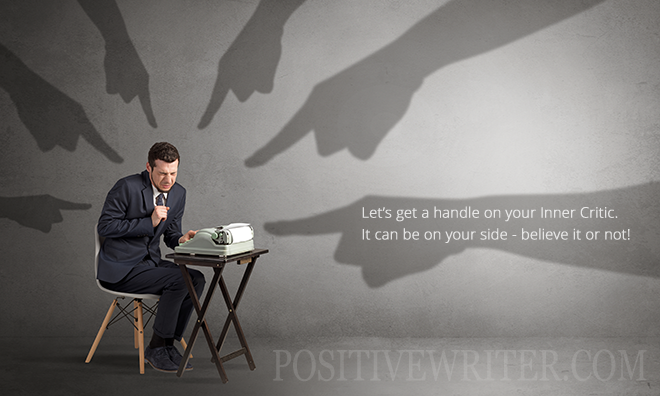
Now let’s get a handle on your Inner Critic. It really can be on your side – believe it or not!

In this post, we’ll look at three ways it can be your best friend instead of your worst enemy.

Your Critic is a Refiner, Not a Destroyer

Ovens heat things. It’s what they do.

All ovens aren’t alike.

Some ovens are for pottery. You put your art in and in time you bring out a masterpiece. That’s a refining oven better known as a kiln.

Funeral homes have ovens, too. They’re used to turn your loved ones into ashes.

Which kind of fire is your Inner Critic?

It depends on what you use it for.

You can use it to make you better or bitter.

You use it to make you better with a few simple steps.

First, write your draft fast. Give yourself a prompt and don’t stop to think. Don’t check for typos on the way. That’s like getting distracted by a squirrel when your daughter is talking to you. Push on. This is a racetrack, not a scenic highway. Get those words down and don’t worry about speeding tickets. There aren’t any on the freewriting highway.

Your critic can take a nap while you vomit out your draft.

This is fun. It’s like jumping into a pool. You get refreshed by getting in the water. If you stop to worry about how cold the water might be, you’ll stay on the deck forever.

Once all your words are on paper, take a break. Eat lunch. Take a nap if you’re into that. You might be tired after all that effort anyway. Give your brain time to reset.

Then come back and edit.

Jody Picault famously said you can’t edit a blank page. No worries! You’ve got a page that if filled to the borders.

Now let’s consider the point of editing, shall we?

You aren’t here to tear yourself apart. You’re editing your words. You’re looking for impact – specifically, the one you intended when you sat down to write. Did you trigger the reader’s emotions? Pretend like this is someone else’s work. It will seem more like it if your break is long enough. Ask yourself, how can I maximize my impact? How can I use these words to fulfill my purpose.

Then give it all you’ve got.

And please, don’t forget to get excited. Your refining here, not destroying.

There’s a world of difference.

Your Inner Bodyguard

When you’re carefree, pouring out your soul with no inhibitions, you might say something offensive.

Since you’re blazing through your draft, you might miss it. That’s okay. You’re not worrying about it then.

Your Inner Critic can sort it all out.

When you run into something you wrote that gives you pause, ask yourself one question.

Should I say this?

If you’d say it in public where someone could punch you, then go for it.

If you have no doubt you shouldn’t say it, don’t.

If you’re not sure, then you can probably leave it in.

I can’t guarantee no one will be offended. And who knows? Your edginess can give your message the punch it needs to reach your reader when she needs it most.

It’s also a good way to stand out.

Let your Inner Critic keep you from getting a bloody nose. Don’t let it keep you from speaking the truth or making an impact.

Your Critic Has Your Best Interests at Heart

Your Critic is part of you. It’s always going to be there. It’s not trying to sabotage you. It really wants the best for you.

It might not always know what to do, but let’s be honest – do you?

We’re all just doing the best we can.

Sometimes your Critic is worth listening to. Here’s how to tell.

● Will believing this make me better?
● Will this idea really ruin everything?
● How is this in my best interest?

When you answer these questions, you’re using your head instead of your feelings. You’re responding instead of reacting. And more often than not, you’ll find yourself daring greatly and shrinking less.

We’re all wired for survival. Our intentions are usually good (at least as we define them). So when your Critic starts ranting and raving, pause. Understand. Listen to hear what it’s really saying. Are you hurting? Is something wrong? What can we do to make this wrong thing right?

You’ll do this again and again for as long as you live.

The more you do, the less you’ll have to over time.

What you’re doing when you talk back to your critic and question its assumptions is paving new mental pathways. If you’re going to be in a rut, why not be in one that serves instead of harms you?

Guide your own heart. It’s got your best interests in focus.

When you do, the best of you will come out in every word.

I have stories to tell. And so do you!

I have stories to tell. And so do you!

written by Bryan Hutchinson

Today I am happy to announce our 3rd place winner of our annual writing contest, Kimberley Claire Young! Please help me congratulate her. 2nd place and 1st place will be announced over the next few days.

I am a writer.

Not a well-known or a popular or a published one, but I am a writer anyway. I’ve always written little stories, but I never dared to publish anything. I was scared to be judged or bullied for wanting to write stories. But I knew I wanted to write. Just because I could. I was scrolling through an old journal and read a story I wrote 14 years ago when I was a young girl of 13. It was about my cat and all the adventures he’d have when he jumped over the garden fence. I thought it was cute, but not very good. It was fun to see how far I’ve come since then.

I have some brain damage. I had 5 surgeries to have a brain tumor removed and had radiation therapy for a month. I still have the tumor, but it isn’t life-threatening. English isn’t my first language, but for some reason, I prefer to write in English. My life isn’t easy because of my illness, but I still have a voice. And I plan on using it to tell whatever stories that may spring up into my mind.

Recently, I went back to school. I’m studying to become a teacher’s assistant. Last year, I worked with kids from the first grade. I was so sweet to see the kids learning how to write letters. The letters became words, the words turned into sentences and the sentences became a paragraph of their very first story. I loved seeing the wonder in their eyes. Eager to know where their story would go next. I hope that when they reach my age, they’re still writing and make other people happy with their stories.

I have stories to tell. And so do you. I’m proud of how far I’ve come already. My confidence is growing steadily. I want you to know that everyone can be a writer. Just write something, anything! You don’t need to publish it right away, maybe never, but you still wrote something.

This is the beginning of your story. And mine. Let’s see how far we can take this, right?

I’m a writer. And so are you.

12 Ways Writers Can Kick Fear in the Butt and Do Their Best Work

12 Ways Writers Can Kick Fear in the Butt and Do Their Best Work

written by Frank McKinley

When you write something and share it with the world, you might feel like a naked performer at the world’s biggest talent show.

You’re okay when you don’t think about being naked. But then the realization hits you. So you grab all the fig leaves you can to cover up the sensitive areas.

Or maybe you feel so embarrassed you swear you’ll never show your face or tell your story in public again.

It doesn’t have to be that way.

Today, we’ll look at fear – what it really is, and some practical strategies you can adopt so the most common fears writers face won’t have their way with you.

Ready to kick fear in the butt?

Let’s do this!

What Fear Really Means

When you’re not sure what a word means, you look to the dictionary.

Often we use words in ways they weren’t intended. If enough people do it, the use becomes the meaning. If you want to kick fear in the butt before it kicks yours, you should know what you’re dealing with.

Here’s the best definition I could find: 

an unpleasant emotion caused by the belief that someone or something is dangerous, likely to cause pain, or a threat.

When you’re really afraid, your brain freezes. Maybe you don’t feel you can do anything but cower and cover up. But how will you know if you don’t stop for a minute and ask this question:

Is this really dangerous?  

If not, quit worrying and start kicking.

If so, how can you reduce the danger? How can you approach this from strength and not weakness? How can you press on no matter how much your knees knock together?

Dale Carnegie offers a great solution to this problem. In his book How to Stop Worrying and Start Living, he urges readers to ask and answer these two questions:

  1. What am I worrying about?
  2. What can I do about it?

You have more control than you think. Face the worst by making the best of it.

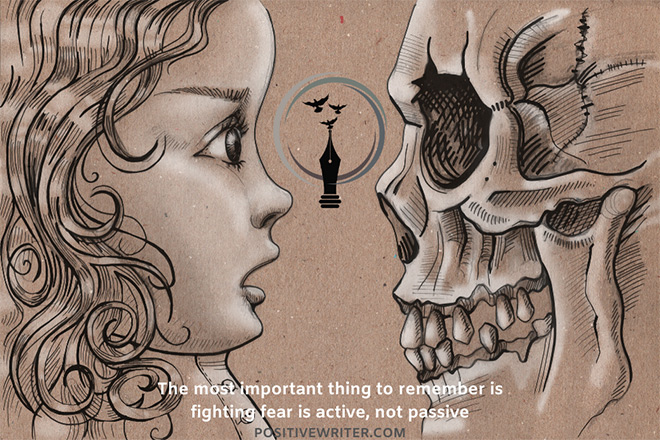
The most important thing to remember is fighting fear is active, not passive.

What follows are tangible ways you can be proactive by tackling the most common writing fears before they arise.

12 Ways to Overcome Fear Before It Grips You

Be as kind to yourself as you are to others.

Sometimes we can be our own worst critics. We hold ourselves to a higher, probably unattainable standard. And when we fall short, we treat ourselves like garbage.

Why?

Because there’s no one there to stop us.

Take time to build a small group where you can be honest and hold yourself accountable. The truth is you could do better, but you could do a lot worse, too. A faithful group that lifts each other with facts instead of opinions is an asset worth more than gold.

Understand your writing isn’t for everyone.

Stephen King, James Patterson, and J.K. Rowling have sold millions of books.

And millions of people still haven’t read them.

If these authors haven’t sold everyone, you won’t either.

Focus on the people your writing serves best. Put your all into it. Then you’ll do your best work and your readers will rave about it.

Proofread effectively.

I’m a perfectionist.

Chances are good you are, too.

We love to write our hearts out. But when it comes to editing, you feel like you’re learning math in an English class. You know you have to do it. You want your work to shine. But busting your knuckles against your words wears you out.

If you’ve poured over your words for hours, you won’t see straight enough to edit them. So take a break. Walk away. Go outside. Drink coffee. Take a nap. Talk to a friend.

When your brain is fresh, come back.

The best way to proofread is to read your work aloud. Better, have your smartphone read it to you. Siri can do it on the iPhone. If you want an app with a voice, tube used Voice Dream and Capti. The voices are eerily human, and they won’t fill in missing words like your brain will.

Once you’re happy with how your words sound, share them.

Compete with yourself.

The best person to beat is who you were yesterday.

Learn from others. Make their strategies your own if you can. But at the end of the day, you’re still you. So be the best you can today. Write what you care about. Dig deep and share your best insights.

The people who care will share.

Collect ideas before you run dry.

You don’t wait until Christmas Day to start shopping.

You don’t let the train run over you before you move out of the way.

So why expect your short list of ideas to last forever?

It won’t.

Squirrels gather more nuts than they can eat when it’s warm. They do it because they know winter’s coming and they’ll starve if they don’t gather food while it’s available.

Keep a notebook with you. Write down every idea on your smartphone. Don’t worry about quality. You can sift later. For now, just hunt and gather.

You can’t sift through nothing.

Protect your writing time with your life.

How much you write will depend on how strong your habit is.

Find your best, most productive time and space. When can you work uninterrupted? When do you feel most creative? What does it take to light the spark?

Figure that out.

Put that time on your calendar.

And don’t miss it unless you’re dead.

One more thing… don’t schedule writing at the expense of your family and friends. Success is more fun when you have others to enjoy it with.

Always be learning.

If you have a degree, that’s great.

If you don’t, you have experience to draw from. You have imagination. And you can always learn more.

Read books and go to seminars.

Join communities of people reaching higher.

Explore what’s possible by stretching yourself.

Knowledge is powerful when it’s used, regardless of how it’s obtained.

Embrace the challenge of getting published and read.

It’s not easy to sell your writing.

Traditional publishers are pummeled with countless requests to publish manuscripts.

Anyone can self-publish, but only a few stand out.

You can win at this game if you want to.

Find your unfair competitive advantage. What is it that you do so well it’s hard to copy you? There’s gold to be mined in that talent.

Dig deep. Dig often. Move the dirt away and you’ll shine like the sun.

Count rejections as steps to yes.

It hurts to think your writing doesn’t fit everywhere.

You’ll have to take some stabs in the dark to find the light. You’ll fall and scrape yourself when you’re learning to ride your bike. The person you want to dance with won’t want to dance with you.

It’s okay.

Finding where you fit takes work. And like a pair of shoes, you may not fit into the same groove forever. Keep shoes on hand so your feet don’t get cold.

Break a big project into finishable tasks.

You can’t eat an elephant in one bite or even one meal.

We’re celebrating the Christmas holidays as I write this. You’re tempted to eat too much, spend money you don’t have, and watch way too much TV.

We built our home two years ago. It took over a year to complete. The construction consisted of a series of projects: framing, wiring, plumbing, flooring, insulation, sheet rocking, roofing, and a half million other tasks.

We finished it all by focusing on one task at a time.

We also knew why we had to do it all.

Break your book down into daily tasks. Check them off. Set up some milestones to celebrate along the way. It’s a marathon, and the rewards can be huge.

Schedule time to write.

Life is demanding.

You make time for what’s important no matter how stressed you are.

If you care about writing as much as you do eating or breathing, put it on your calendar.

Do it regularly and you’ll find you can’t live without it.

Plan to make money before you spend it.

If you have seed money to start your business, great.

If you don’t, you’ll have to call on your creativity.

Find some influential people and do something for them. Don’t expect anything in return. If you impress them, some of them will surprise you.

No business can last without cash flow. Let the right people know what you offer. Do it consistently.

Soon you’ll be the one that feeds their hunger.

Now go kick fear’s butt.

Fear will always be there.

The best way to deal with fear is to head it off before it shuts you down. You’ve got 12 fighting techniques now, and a better than average chance of winning.

Now go claim your rightful place in people’s hearts.

Writing Contest: Your Calling Your Story

Writing Contest: Your Calling Your Story

written by Bryan Hutchinson

This year’s writing contest is all about telling YOUR story as a writer.

When did you know writing is your calling?

What led you to become a writer? What did you go through to get here? Do you remember the moment you realized writing is your calling? Or, did it come to you gradually? How did you feel when you finally realized it?

Tell us about your confidence. Were you always confident to share your work?

Tell us about your doubts and fears. Do you ever feel doubtful? If so, how did you, or what are you doing, to overcome it? Share your trials and tribulations, your elations and your successes.

This writing contest is about helping others see the potential within themselves.

How are you going to do that? I don’t know. But what I do know is: You Can do it.

You are a writer. More than that, you are an inspiration. We need your words. We want to be touched by them, moved by them, and compelled to believe… to believe we’re better than we give ourselves credit for. That anyone with the desire to be CAN be a writer.

You have this power. I know you do. In days like these, we need you to use it.

My suggestion is to write as if the goal of this contest is more important than winning it.

With that said, I do have some prizes for you. 🙂

The Contest:

It’s easy to enter. Write an essay (blog post) with the single purpose of getting those who read it to believe in themselves and their calling, using your experience as inspiration.

I’m not looking for technically perfect posts. I am looking for essays I believe will encourage others to face their challenges and ignite their passion for life and writing. That’s it. I think any further criteria will only inhibit contestants from writing their most inspiring work. Just write it, post it, and we’ll go from there.

This contest ends 15 Dec 2019.

No entry fee.

The prizes are:

1st Prize:

->) $95.00 Amazon gift card + All-New Fire 7 Tablet (7″ display, 16 GB)

2nd Prize:

->) $75.00 Amazon gift card

3rd Prize:

->) $50.00 Amazon gift card

– – – – – –

How to enter the contest:

  1. Post your essay between 300 to 1000 words on your blog. (You need a blog. If you don’t have one yet, it’s easy to start one on WordPress, or even easier, on Medium.)
  2. Consider leading into your post with: “I am participating in the Writing Contest: You Are Enough, hosted by Positive Writer.” You can phrase it as you like, but make sure there is a direct link back to this post to qualify.
  3. Paste the link to your entry in the comments below.
  4. Subscribe to Positive Writer. One of the perks of subscribing is being able to enter our writing contest. It’s free. Only subscribers can win.

It’s very important that you put your link in the comments to this post because that’s your official entry.

The winners (and runner ups) will be announced via blog posts here on Positive Writer. The best way to stay updated is to subscribe. Also, if you want to be reminded about this contest, subscribe. You can subscribe now, (click) here.

All 3 of the winning posts will be republished as guest posts on Positive Writer. (Awesome exposure for you.)

Most bloggers are looking for a fresh topic to write about, so here you go, you just so happen to be able to enter it into a fun contest, too.

We need your words.

Now go, write that winning post which will inspire people for years to come.

If you have any questions, please ask via the comments section below.

NOTE about entries: If you enter an essay into this contest you agree to allow free use of the article for possible publication as a guest post on Positive Writer, used in compilations, ebooks and other means with full credit to you as the author. This contest is void wherever prohibited.

Why Now is the Best Time to Write Your Story!

Why Now is the Best Time to Write Your Story!

written by Frank McKinley

Do you have a book burning inside you and the fire is so bright you can’t ignore it?

Is there a story in your heart that you must write – and if you don’t, you’ll die with a thousand regrets?

Is there a lesson you can teach in a way that no one else can, and if you don’t the world will miss out?

Good. Now is the time.

This post is by Positive Writer contributor Frank McKinley.

But I’ve got some really good reasons why I haven’t started…

Of course you do.

And I know them all, because at one time or another, I’ve used them to keep my writing in the closet.

When I was young, I wrote a lot. I didn’t share it because people treated me like I didn’t matter. I was hurt already. I didn’t want to risk being targeted as a fool for daring to be creative.

Pain makes us hide.

It puts up walls where there shouldn’t be walls.

I have a friend who has gone through unimaginable pain, way more than I ever have. We’re in some of the same writing groups. I’ve encouraged her to share her story, even if it’s just a piece or two.

Last week, she took the plunge. She wrote about how scared she was of writing publicly. She shared it in the group.

It was freaking brilliant.

I thought to myself, “Where have you been hiding this talent?”

Then I told her how great it was.

The words you put on the page matter. But the words you give to other writers encouraging them to press on and do the good work of writing and sharing can be life changing.

Today, if you’ve been waiting to write and share your story because it’s not perfect yet, or all your ducks aren’t in a row yet, or you’re too scared to start – consider this your invitation to begin.

The time is now.

Now is the best time to write your story! Click To Tweet

Here are three compelling reasons why today is the absolute best day to start.

You don’t have to have all your ducks in a row before you write.

The experts that tell you that you need an audience first are trying to help you.

But what they might be doing is giving you a severe case of writer’s block.

Here’s how that looks when you talk to yourself:

  • I don’t have 10,000 followers on social media, so no one will take me seriously.
  • My story has been told by others 50,000 times already. Why bother?
  • I’m not Stephen King. What makes me think I can sell a single book?

Shut up.

Social media can be valuable. But it’s a borrowed platform. So is Medium. The owners can change all the rules whenever they want. And as inconceivable as it may seem, they can even fail.

Where will you be then?

You could – and should – have your own blog. But that will cost you a little money. If you’re short of cash, your host won’t cut you a break.

None of these are platforms. They’re stages. They’re where people come to see you, read your work, and applaud your efforts.

Your platform is your message, your story. You take that with you everywhere. And it’s yours until you die.

So wherever you go, there you are. And so is your story. The best thing you can do is find a stage where your message fits. Metal bands don’t play at the Grand Old Opry. Symphonies don’t play in smoky downtown bars. You don’t wear jeans that are three sizes too small.

There’s a place for you to shine.

It’s up to you to choose yourself and find it.

The time is now.

Write your story and build your following while you’re working.

Don’t let perfectionism and procrastination keep you quiet and make you hide.

You won’t be better tomorrow if you don’t write today.

There are no perfect writers.

If you’ve been sold that myth, I’m sorry.

What seems perfect is really just successful. And success looks different for every bestselling author.

So how do you define “success”?

Success means your message is reaching those who want to hear it.

You can’t go back and do the past differently.

You can dream of the better future that is possible.

It won’t happen if you don’t write something today.

Don’t worry about it being perfect or mind-blowingly awesome. Just be honest. Spill your verbal guts. Say something that scares you, and maybe even seems a little raw.

How do you know it’s safe?

If you don’t feel a definite “No” rising up inside you when you’re editing, leave it in.

Queasy feelings are okay.

Wondering how people might react is permissible.

Just don’t do something you know you shouldn’t, and things should work out okay.

Don’t let perfection keep you from sharing something that’s close enough to perfect.

Today is the first day of the rest of your life. Your forever begins now.

Your readers are waiting.

If you keep your story bottled up, it will ruin you.

I know, that’s a pretty bold statement.

But think about it.

Have you ever gotten really excited about something, but your Inner Critic talked you out of it?

How did that make you feel?

Sad?

Resentful?

Angry?

I’ll bet it burned away inside of you because you bottled it up. You may have even told your friends, but since you never took action, you’re ashamed to talk about it anymore. Maybe they feel sorry for you that you had such a big dream. Since it was so big, they don’t blame you for giving up. Who wouldn’t?

Hogwash.

Give it a chance.

How can you know what it will look like if you don’t chase it? How will you know the impact your story could have if you never write it or share it?

Consider this your kick in the pants.

And if you need a community to encourage you, I can hook you up with one no matter where you live.

Don’t break your own heart by denying it what it wants.

You could be three feet from gold.

Start Now

Chances are if you’re reading this blog, you’re doing some writing.

That’s great.

Wherever you are in your writing, you can always do more. More words. More sharing. Or more of a balance between the two. All you need to do to call yourself a writer is write.

When you share regularly, others will call you a writer.

What’s your story? What do you feel compelled to share with the world? What do you have that can make us all better? Who are the people who matter who will receive your words with joy?

Find them, and do the work.

If they don’t respond right away, here’s an analogy.

When you need shoes, you go to the store and see what’s available. There are dress shoes, athletic shoes, and shoes you wear to goof off. You pick the appropriate style and try some on. Some will fit, others won’t. Walk around and see how you feel before you give the shopkeeper your money.

When you find the perfect pair, you know.

It may take time to find where your story fits. That’s okay. You’ve got to try it out in different places. When you find a fit, stay there and keep writing until it doesn’t work anymore.

When your shoes wear out, you buy another pair. You don’t stop walking when you get holes in your soles. When your writing doesn’t fit anymore, find a place where it does.

And trust me, there is a place.

It may be a long road, and you’ll have to take every step.

Start now.

We need your story.

Your Next Move?

Don’t quit. Read This Next!

The Truth About Believing in Yourself

The Truth About Believing in Yourself

written by Bryan Hutchinson

Announcement: Today’s post is by Ivy Shelden. She’s the 2nd place winner of the “You Are Enough” writing contest! Please join me in congratulating Ivy for her inspiring entry.

Finding authentic faith in artistic expression

I remember my first “vision board.”

I spent all day feverishly cutting out photos of old bungalow-style houses with porch swings, beach vacations and strong, fit, successful women. I printed out my bank statement and added a few zeros to the balance. I typed and printed the words, “New York Times Best Selling Author, Ivy Shelden” and plastered it among the other photos and clippings.

Here we go, I thought. Now I’m ready to start believing in myself.

I stared at the board until my eyes crossed. Next to the vision board, I’d printed a list of “affirmations” to say aloud each day, until I believed them. They included statements like:

I am worthy of, and open to abundance.

I am thankful for my new job. (I didn’t have one yet)

Every morning I stood in front of that laundry room door — staring, reciting.

Strangely, nothing in my life changed. I remained terrified to sit at my computer and express myself through writing — let alone share my work with anyone.

I felt even more empty, staring into the faces of women who weren’t me, and houses I didn’t own. Uttering words I didn’t believe.

I felt defective for not having stronger faith.

I tried praying and meditating. I read every self-help book in my local library, followed every life coach’s blog. Still, no change.

I thought, Why do I still doubt my potential when I try so hard not to?

As I hovered a trembling finger over the download button to another audio book, I paused. Instead, I tossed my phone to the side and sat quietly, eyes closed.

Although my body was still, I could feel my mind screaming for more action. We need to do something it pleaded, everything we want is slipping through our fingers!

I recognized that voice in my head: Fear.

Fear of missing out.

Fear of not fulfilling my true purpose.

Fear of my talent withering on the vine.

Fear was driving my self-help obsession — my reading and podcast addictions. It pervaded the photos on my vision board — dripped from my affirmations.

My vision board felt like a highlight reel for everything I was lacking — it created distance between myself and my true desires.

There they are, and here I am. Separate. I must wish myself up to their level.

And you know what I wasn’t doing while I was creating that vision board?

Writing.

Go figure that one. I realized that my self-help gimmicks were also a convenient excuse to avoid what scares me most: engaging my gifts, and making myself vulnerable to criticism and failure.

I thought I needed to be in the right frame of mind (i.e. believing wholly in my abilities) to even start working.

No blogger or self-help book can teach you to believe in yourself. You have to pop those earbuds out, drag yourself up off the couch, and work. Day after day, no matter how messy or imperfect the result.

You must see yourself persist through fear and uncertainty, time and time again, to develop self-trust.

You don’t need a list of affirmations. You only need to believe it’s possible to make a difference in the world with your art.

You don’t have to be perfect or know everything, you just have to begin. And keep going.

Do this, and you’ll accomplish far beyond anything you could ever paste on a vision board.

Why Marketing Kills Writers (and What You Should Do Instead)

Why Marketing Kills Writers (and What You Should Do Instead)

written by Bryan Hutchinson

In today’s world, to be a writer we’re told that writing is not enough, you must market your work and do everything in your power to get the word out, even before you’ve written a sentence of your brilliant to-be manuscript.

Read More

Newer Posts
Older Posts

writers doubt book on writing

"Bryan's book, "Writer's Doubt," Will dispel any writer's doubt! Highly Recommended!" — Warren Adler, author, "The War of the Roses".
.
Writer's Doubt is an Amazon Exclusive Release.  Please note, all links to Amazon on this site are affiliate links.

Are You A Writing Warrior? If Yes, Join Us Now!

Hello! I'm Bryan Hutchinson, you might know me as the author of the bestselling book, "Writer's Doubt." On Positive Writer I help writers and bloggers do what they were born to do: Write and get attention! I'd love to keep you up to date and share my best tips with you:

Like Positive Writer on Facebook

SuperWebTricks Loading...

Become A Better Writer

Ready to improve your writing and your life?

Join The Art of Positive Journaling!


“I’m a fan!” —Jeff Goins, author of Real Artists Don’t Starve


  • Facebook
  • Twitter
  • Google +
  • Pinterest
  • RSS

Copyright © Bryan Hutchinson


Back To Top