Positive Writer
  • Inspiration
  • Writer’s Doubt
  • Free eBook Good Enough
  • Contact
    • Guest Post Guidelines for Positive Writer
  • Resources
  • Archives
  • About
    • The Wee-Jees Book Launch Team
      • Picture Files for the Book The Wee-Jees
    • Privacy Policy
    • Free Book
  • Inspiration
  • Writer’s Doubt
  • Free eBook Good Enough
  • Contact
    • Guest Post Guidelines for Positive Writer
  • Resources
  • Archives
  • About
    • The Wee-Jees Book Launch Team
      • Picture Files for the Book The Wee-Jees
    • Privacy Policy
    • Free Book

Positive Writer

Category:

Writing

Why it’s So Much Better to Write to Express, Not to Impress

Why it’s So Much Better to Write to Express, Not to Impress

written by Frank McKinley

Have you ever watched a magician make his assistant levitate just by waving his hands?

Here’s what happens.  Two dancers come onto the stage to set the exotic atmosphere.  Once we’re in the mood, the magician’s assistant comes out and lies on a board supported by two chairs.

The magician puts the assistant into a trance. The dancers cover the assistant with the blanket on the board.  They remove the chairs and the magician begins waving his hands.

Magically, the assistant rises.  The magician passes a hoop around the assistant so we can see clearly that there are no ropes or wires lifting the board.

Amazing!

The audience claps and the magician does another trick.

Impressing is a strategy.

Wouldn’t it be great if your readers would be so riveted to your writing that nothing could stop them from reading every word?

What writer doesn’t want that?

Impressing is important, we’re told. If you can’t grab attention, you won’t get a chance to make an impact.

Consider the magician.  They’re making an impression all the time, aren’t they?  And they do it so well, they don’t even have to share their hidden message.

And what might that message be?

It’s okay to believe in magic.

Be careful not to overlook this fact.  The greatest magicians plan to show us that we should believe in magic.  If they just told us, then we’d dismiss it. If they didn’t plan for this, their shows wouldn’t be as good.

When the assistant rises and we can’t see why, we’re convinced (even if only for a moment).  The magician isn’t forcing us to believe.  They’re just presenting a picture and leaving it to us to interpret what we saw.

You impress with a headline or a startling statement to begin your blog post, your essay, or your book. Once you’ve got people’s attention, you’ve got one shot to make your message clear.

That’s where expression comes in.

Expression is a goal.

What impact do you want your writing to make?

The time to ask that question is before you write the first word.

Knowing what you want to accomplish helps you draw a map to get you there.  What road will you lead the reader down?  What sights will the reader see along the way?  What signposts will give hints for what is to come?

The words you choose will depend on the point you want to make.  Consider what the reader might be thinking when they find your piece.  What are they feeling?  What do they believe?  What do you want them to think or feel after they read?

To make your message clear, narrow your focus.

Narrowing means you pick one problem and provide a solution for it.  It means you tell one kind of story for one kind of reader.  To do more is to spread yourself thin and dilute your impact.

When you have one main point, it’s like a tour guide that directs you as you write.  It’s the ruthless editor that helps you cut out everything that doesn’t make your point. It’s the magnifying glass that excludes everything that doesn’t add to your message.

I grew up drinking sweet tea.  The first time or two I made it myself was a test.  I might add too much sugar or too much water.  Or maybe too many tea bags.  When it doesn’t taste right, you might suffer through a glass or two, but you can’t bring yourself to drink a whole gallon.

Your writing is a lot like sweet tea.  If you want your readers to enjoy your writing while they drink it in, suit it to their taste.  Be willing to test—and fail.  Analyze what happened, adjust your focus, and try again.  In time and with practice, you’ll find the right recipe.

You need both to make an impact.

To influence people, you have to draw them to you.

It’s not enough to open the door.  You’ve got to have something appealing inside.  If you bore them after you grab their attention, they’ll walk out on you.

TV producers are experts at this.  They tantalize you with the juiciest clips while you’re watching something else.  If they succeed, then they have to make watching so good you’ll go on a binge.

Think about your favorite shows.  What got you hooked?  What makes them so good you want to tell all your friends about them?

Here are a few:

  • Open loops – They show you a problem but withhold the solution until you watch. Characters you can identify with – When the hero seems like you, you think of them as a friend.  You see yourself in their shoes.  You may even find yourself rooting for them or talking to the screen to tell them what to do.
  • They sell hope – Have you had a bad day and want to laugh? Do you want to be as confident or skilled as your favorite character?  A few minutes escape can be just what the doctor ordered.

What can you add to this list?

Then ask yourself, “How can I use these techniques in my own writing?”

If you need help, take out one of your favorite author’s books.  Read for an hour.  Then grab a cup of coffee (or your favorite beverage) and write down the ways they capture your attention.

Then grab a pen and implement those techniques into your own writing.

Start with one strategy and implement it every day for a week.  Then add another the next week.  Soon you’ll become your ideal reader’s favorite writer!
13 Limiting Beliefs That Hold Writers Back

13 Limiting Beliefs That Hold Writers Back

written by Bryan Hutchinson

In the Spring of 2016, my book, Align Your Writing Habits to Success, hit #1 in my category on Amazon and I became a bestselling author. That same year, two more of my books also hit #1. It happened again the next year and again two years later. 

Now, it’s pretty common for me to release a new book and have it hit #1 in my category.

But before that, being an Amazon Bestselling author was a pipe dream. Something I knew was possible for other people, but I didn’t think it was for me.

NOTE: This is a guest post by Jennifer Blanchard, a multi-passionate author of both fiction and nonfiction, and the Feel-Good Life + Mindset Coach who helps writers, creatives, and dreamers shift their mindset and own their worth so they can achieve their dreams. If you have big dreams, but always get caught up on How to make them happen, be sure to download her FREE training: F*ck the How. 

Why did I think it was a pipe dream? Two reasons:

  • I didn’t know How to make it happen 
  • I had a limiting belief that said it wasn’t possible for me

Then in February of 2016, I met an author who had written and published 47 books, 46 of which hit #1 in her category on Amazon. Meeting her got me thinking: if she could hit #1 that many times, surely I could do it once. 

That thought shifted everything for me, and less than four months later, I joined the ranks of Amazon Bestselling authors. 

Limiting beliefs run rampant in your subconscious mind, and these beliefs stop you from pursuing your desires and believing your dreams are not only possible, but inevitable. And if you don’t deal with your limiting beliefs, they will hold you back from ever having the writing career and the life you truly want.

First, what is a limiting belief? It’s a belief that limits what’s possible and available for you. 

Limiting beliefs are rooted in misperception, and everyone has them. It’s your job to figure out what yours are, then deal with them, and let them go. 

To get you started, here are 13 of the most common limiting beliefs I see from writers and creatives (and why they’re not actually true): 

Writers are broke

This one has been said so many times it plays like a broken record in many writers’ minds. 

Not only does this limiting belief stop you from making money as a writer, but it also stops you from even doing your writing or putting it out into the world. If you think from the get-go that being a writer means you’ll be broke, why would you ever allow yourself to be a writer? 

But the truth is, not all writers are broke. I’d argue the only writers who are broke are the writers who aren’t resourceful, who haven’t done the due diligence to learn what it takes to make money from being a writer, and who haven’t consistently implemented what they’ve learned.

And I would argue this because if you are resourceful, you do learn what it takes to make money as a writer, and you implement it consistently, you will make money eventually. That’s how it works. 

You’re only a published author if your book was traditionally published 

Let’s look at the very basic definition of published: to prepare and issue a piece of work for readership or sale to the public. With this definition, a blog post–much like this one–makes you a published author. 

Same goes for self-publishing your book(s). 

If you’ve prepared your book and issued it for readership or sale to the public–congratulations, you’re a published author. If someone can find your book on Amazon and read it and/or buy it, you’re a published author. It really is that simple.

The problem is when you allow someone else’s limiting beliefs around what it means to be a published author affect you and the way you think about yourself and your writing.

I shouldn’t have to spend money to be successful as an author 

You’ve probably heard the old saying, “you have to spend money to make money.” You’ve maybe even said that yourself or believed it at some point. 

But that doesn’t mean it’s ultimately true for everyone. It is possible to make money without spending money. 

The real question is: do you want to be a hobbyist or a professional? 

A hobbyist writer doesn’t see the value of investing in their writing career. A professional writer knows that allowing yourself to be supported by investing your money in whatever you need for your career–be that an editor, a coach, a cover designer, a how-to book or course, or something else entirely–is a win-win. 

That doesn’t mean you have to spend a ton of money to be a professional. This is more about making a mindset shift from not seeing the value in investing in your writing career to seeing that when you invest in your career, that investment returns to you in multiple ways, money included.

Writing isn’t a career with longevity

Ugh, I hate this one! And I get it. I really do.

As a writer who was told many times that writing “isn’t a real job,” I can tell you with absolute certainty writing is a career with longevity. I’ve been getting paid for my writing since 2001. All these years later, still getting paid.

The issue at hand here is two-fold: 

  • Are you willing to stay the course? 
  • Are you willing to pivot and learn new things as the industry and marketplace shifts and changes? 

While being a writer is still the same thing as it has always been–sit down and put words on the page–the way writers sell their books and make money from their writing has shifted over the years, and will continue to. 

If you’re a writer who wants to have a long career, you have to be willing to stick with it and change and grow as the industry and marketplace does.

It’s hard to make money as a writer

This is one of the most common limiting beliefs, and it’s deeply rooted in misperception. 

It’s not that it’s hard to make money as a writer. There are plenty of authors out there making five and six figures a year and even a month from their writing.

A coach-friend of mine sold 7,000 copies of her book at $4.99 a copy when it first came out. At a 70 percent royalty, she gets about $3.49 per book. Now multiple $3.49 times 7,000 and you’ll see that she made around $24k. It was not hard for her to make this money. She just sent out a few emails and put a few posts up on social media.

So the misperception here is that it’s hard to make money as a writer, and clearly, that is not the ultimate truth. 

For the writers who have had the experience of it being hard to make money, there were most likely other things at play, such as not having the right audience or a big enough following to sell books to, or having a limiting belief that said it’s hard so it became a self-fulfilling prophecy 🙂 

I’m not good at marketing 

When you think about marketing as this big hairy-scary thing, yes, it can be intimidating and it might make you think you’re not good at it. 

But when you break it all down and look at marketing for what it actually is, you’ll see how easy it can be to be good at it. And here’s a breakdown: marketing is simply showing your audience who you are, telling them about your book, and giving them a specific action you want them to take.

When you look at marketing from that lens, it feels less scary, right? 

Here’s a simple example of what that could look like: you write a post on Facebook sharing your opinion about a topic you’re passionate about. You add a P.S. at the end of the post telling people about your new book, then write “buy my book here” and give them the link. 

Online marketers overcomplicate marketing and it doesn’t need to be. Keep it simple and you’ll actually show up and do the work.

Selling is sleazy

When I hear the phrase “selling is sleazy,” I picture those door-to-door salesmen who come to your house and try to sell you a vacuum or a magazine subscription. That kind of selling is dripping in desperation and you can feel the “ick” energy of it. 

But that doesn’t mean that selling, in general, is sleazy. You have to separate “selling” from “sleazy” in your mind because they’re not one and the same. 

“Sleazy” is a specific approach that can be taken to anything, not just selling. And selling is simply telling someone about your book/offer. 

I think the other part of what makes this limiting belief so popular among writers is the idea that you’ll have to “convince” someone to do something, like buy your book. But it’s a choice to see it that way.

You could choose to view selling as being of service, and as you getting your book into the hands of the people who need it the most. Nothing sleazy about that. 

You can also decide that you’re not going to put energy into trying to “convince” anyone of anything. That’s not your job. 

Your job is to share with people who you are, what you have to offer–aka your book–and to let them know why it’s of value and how to get their hands on it. 

I don’t want to annoy people by promoting my books all of the time 

Do you think Amazon or Apple or Starbucks gets up in the morning and thinks, “I shouldn’t sell today because I don’t want to annoy people?” No way! 

They just send you a hundred emails a day and think nothing of it. 

Not saying you have to do the same thing to your audience, but in this day and age, people are used to businesses selling all day every day. If you’re an author, you also own a business, so you get to do the same. 

And if someone is “annoyed” by you selling, they can unfollow you or unsubscribe from your emails. You don’t want people like that in your audience anyhow.

Self-promotion is egotistical 

Here’s a new thought for you to try on: it’s egotistical not to promote yourself.

The limiting belief that self-promotion is egotistical is, again, rooted in misperception. The misperception is that your “ego” wants you to be out in the world being all loud and proud and self-promote-y, and that couldn’t be further from the truth.

Your ego wants to keep you playing small. It wants to keep you “safe” in your comfort zone. 

The last thing it wants is for you to be out in the world every day promoting yourself and telling people about your books. 

So it’s actually not egotistical to promote yourself. It’s confidence. It’s bravery. It’s putting the ego in its place.

You came to this world with gifts to be shared, and it’s egotistical of you to not share them.

Building an audience is hard 

This one goes hand-in-hand with “it’s hard to make money as a writer.” While building an audience does take time and consistency, it doesn’t have to be hard. 

You can choose to see it as fun, as something you get to do, as something you enjoy doing because it allows you to connect with your fans and the people who follow you and your work. 

And yes, there will be things you may need to learn in order to build your audience, but that doesn’t have to be hard either. You can set aside 30 minutes a day to learn, and then when you’re ready, 30 minutes a day doing activities to grow your following. 

How you choose to view building an audience is really what makes it hard or not. 

Self-publishing isn’t taken seriously 

Nonsense. Yes, maybe that used to be true, but it’s not anymore. Self-publishing has grown in popularity so much that many traditionally published authors are leaving their publishers, or becoming a hybrid author and adding self-publishing into the mix. 

Now that doesn’t mean you should just write whatever the heck you want and then slap it up on Amazon. Self-publishing doesn’t mean you don’t have standards. 

When you self-publish, you should do as good of a job, if not better, than a traditional publisher would. And that means doing things, like hiring an editor, a cover designer, a copywriter to write your Amazon copy, or whatever you need to self-publish your book in as professional a way as possible. 

There’s a wide variety of self-publishing options available these days, some of which are almost exactly like working with a traditional publisher, except for you foot the bill and get to keep more of the royalties.

I don’t have the money/resources/time to sell my books 

We’ve already covered the money part (see above), but this limiting belief is rooted in the misperception that selling books requires a lot of time, money and/or resources. That is not at all true.

The truth is, you can sell books organically in 30 minutes a day if you’re consistent with it and have the right mindset, energy, and strategy. You can also sell books using an automated book sales funnel and only have to spend the time once to get the result over and over again. 

Don’t allow the fear of marketing or the fear of not being able to sell books make you believe limiting things like selling books requires a lot of money/resources/time. 

Selling books requires whatever you’re willing to give to it. Period.

I can’t write nonfiction and fiction 

So many fiction writers think they can’t write nonfiction. So many nonfiction writers think they can’t write fiction. But it is only their thinking that makes it so.

I used to feel the same way. I’ve been writing fiction since I was 11, and I never, ever thought I’d write a nonfiction book. Then in 2010, I had an idea for a nonfiction book that I wanted to write.

I wrote it, published it, and the rest is history. Now, I have a collection of nonfiction books, and I’m beginning to increase the number of fiction books I’ve published as well.

The real issue here isn’t whether you can or can’t write fiction and nonfiction. The issue is whether or not you want to.

It is absolutely possible for a fiction writer to write nonfiction, or for a nonfiction writer to write fiction. But you have to want to. You have to be willing to learn the differences and practice implementing them in your own writing. 

If that’s not something you want to do, that’s perfectly okay. Just don’t limit what’s possible for your writing career by believing something as silly and limiting as “I can’t write fiction and nonfiction.” 

How To Deal With Limiting Beliefs:

I could keep going with this list of limiting beliefs and showing you why they’re not actually true, but the whole point is this: you get to decide. You get to decide what is and isn’t true for you. 

And unless what you’re coming up against is Ultimate Truth–as in it’s true for every single person on the planet, like gravity–you’re just dealing with a limiting belief and there’s always another option available. 

Here’s my process for looking at and clearing out any limiting beliefs that come up: 

1. Write down what’s currently present for you

Before you can deal with anything, you first have to get clear on what’s coming up for you. I like to get my journal, sit somewhere quiet, and then ask myself: “what’s coming up for me right now?” Another way to ask this is, “why don’t I believe I get to have X” with “X” being whatever you desire that you don’t believe you can have.

Whatever comes up, write it down. No judgment.

2. Is this ultimately true?

Now, go through each limiting belief that you wrote down and ask yourself, “is this ultimately true?”

As I mentioned above, ultimate truth means something is true for everyone, like gravity. If it’s not the ultimate truth, that means there’s another option available.

So, is it ultimately true that “it’s hard to make money as a writer” or that “people get annoyed by self-promotion,” or that you’re “not good at marketing,” or whatever other limiting belief is coming up for you? Of course not.

And if it’s not ultimately true, you get to choose something else.

3. What could be true instead?

This is where you get to now disprove the limiting belief, by telling yourself what you actually want to believe as true, and then finding examples to back it up.

For example, if your limiting belief is “it’s hard to make money as a writer” or “writers are broke,” find examples of self-published authors who make bank. There are a lot of them out there if you do your research.

Someone to check out right now would be Amanda Frances, a business and money coach who just self-published a book and sold more than 10,000 copies, outranking all of the books in both the Self-Help and the Women and Business categories on Amazon, including big-name traditionally published authors.

4. Claim what you actually want as if it’s already yours

Write down the new belief you’re now claiming for yourself. Something that is in opposition to the limiting belief.

If your limiting belief says “writing isn’t a career with longevity,” you now write down and choose to believe “writing is a career that grows and expands as the years go on,” or whatever belief would feel good to you.

The most important part is that you come up with a new belief that feels good when you say it and think it.

5. Repeat this process daily and/or whenever a limiting belief comes up

Repetition is required when reprogramming your mindset and beliefs. So stick with this, do it every day, and your life will begin to change in ways you can’t even imagine right now.

Which of these 13 limiting beliefs most resonates for you, and what are you going to do about it? Share in the comments.

Reimagining Writers’ Responses to Rejections: Merely Paper Cuts

Reimagining Writers’ Responses to Rejections: Merely Paper Cuts

written by Bryan Hutchinson

There is always room for your writing in the world. If you seek it out with determination, your work will reach places beyond your wildest dreams.

NOTE: This is a guest post by Margaret Moore, she is a 2020 Magna Cum Laude graduate of Fairfield University with a Bachelor of Arts degree in English/Creative Writing in May of 2020.  Her work has appeared in Kairos: A Journal of Rhetoric, Technology, and Pedagogy, Brevity’s Nonfiction Blog, and Independent Catholic News among other publications.  She is now pursuing her MFA in Fairfield University’s Master of Fine Arts in Creative Writing Program.

In July 2020, I had a poem published by Independent Catholic News. I think of myself as both a poet and a prose writer, but I am more experienced with publishing nonfiction prose. This was my first time attempting to publish poetry professionally.

Through the lens of faith, my poem, “A Prayer to Shine Through,” responds to the monumental issues our world has been facing this year. Following Saint Ignatius of Loyola’s Examen prayer, the first part acknowledges that people are profoundly struggling. Inspired by the Ignatian idea of finding God in all things, the second part highlights how faith and God can still be found. The piece concludes with a prayer that we continue to see signs of hope.

Though I plan to further my study of poetry as I pursue my MFA in Creative Writing, I have only taken one undergraduate poetry course. I knew that my work required more revision and craft elements to be a literary piece. I wanted to publish it anyway as it may be a source of hope for others. I also knew that literary publications typically release new issues quite some time after the work is submitted.

My poem seemed like it would help people if printed during these times, not months after. News outlets appeared to be the best option. I submitted to local and national publications that printed pieces addressing faith and current events. Most depicted faith positively but hinted at struggles—a major factor influencing my decision to submit.

I remember reading through the submission guidelines and cringing at the maximum accepted length—twenty lines for one magazine, forty for another. As my piece was over one hundred lines, I decided against attempting to condense to twenty—too much would be lost.  I did, however, condense to forty lines. The magazine that I was submitting to is one that I admire. I knew that, if I did not submit it, I would always wonder whether it would have been accepted.

Trying to cut and move over eighty lines was a major challenge. Reading some articles helped. One discussed how line breaks emphasize ideas. I had learned this in class, but having a reminder gave a fresh perspective. Did I really need certain articles like ‘the’ and ‘a’ on their own lines? No, it seemed more effective to break a line on actual keywords, so I revised accordingly. Some stanzas mirrored others, depicting the same idea in different wording. I cut the duplicates and reworked those remaining to have the keen details of the discarded ones.

Although I was pleased with my submission, I felt a faint tug of disappointment afterwards. Many revisions were for the best, but some did not do the piece justice. The editors would not see the power of the unique line breaks and repetition that had originally been there. Part of me felt like I sent a synopsis rather than the poem itself.

When the rejections came, it was naturally disappointing, but it was not the end of the world. In my twenty-three years, I have seen my father die of cancer and my mother overcome the obstacles of single parenthood. I am physically disabled and rely on a motorized wheelchair and an Assistive and Augmentative Communication device. Looking at our struggles and at the world now, the rejections do not even compare.

Rejections are just like paper cuts. We all must endure them regardless of age or level of experience. They appear when the writer is finally seeing the rhythm of the work—when the thought comes that this piece could actually be a page-turner. As soon as the writer moves in a direction that goes against the angle sought by editors, the rejections appear, tearing the skin of the writer.

It is important to note the size and magnitude of the paper cut of rejection. It is tiny. The cut stings at first, but the sensation lasts for a matter of moments. Pain may remain in the following days, but the cut will heal, dissipating into nothing but tough skin.

Too many writers mistake rejections as a sign that they do not have what it takes to succeed. Rejections do not mean that the writing is bad. Editors may love the piece and see its potential to touch readers. If its content or style is beyond the publication’s scope, they are simply not at liberty to take it.

I knew I needed to keep pursuing the poem’s publication. The words, raw and honest, had flowed just right, braiding together emotion, hard truths, and bright insights. This was a piece to be shared widely. I just had to find the right avenue. I began to think more strategically than I had in previous submissions.

Remembering my undergraduate publishing courses at Fairfield University, it dawned on me that it may not be a piece for mainstream publications. I knew that my poetry was not yet at that polished, literary quality that editors seek—I just did not have enough background in craft yet. I knew, too, that mainstream publications look for very specific angles and that mine did not quite fit.

At Fairfield, I learned that independent publications are typically more willing to accept work that is from emerging writers and unconventional in its content, style, and form. I began researching faith-based and Catholic-based independent news outlets and discovered Independent Catholic News, a global outlet based in London, England. Its website features a poetry section showcasing the work of famous poets—Seamus Heaney, to name a personal favorite—along with emerging or lesser-known poets. The poetry focuses on celebrating faith as well as depicting the trials faced by saints, martyrs, and believers.

I decided to write to the editor, sending my poem and asking if she would consider publishing it. I revised my poem so that it was the version that I would like the world to read, taking my original version and working in new wording that the condensed versions helped me discover.

The site did not display submission guidelines, though, and I had no idea if the editor was seeking new works. I decided to take a risk, choosing not to write the typical query letter. I instead wrote an email explaining who I was, what had inspired the work, and my hope that it would help people. My email seemed to adequately explain my poem in a way that query letters had not.

I admit that I paused quite a few times before I finished and sent it. I could not help but ponder what on Earth I thought I was doing. I was a twenty-three-year-old new college graduate and incoming graduate student in the United States, and here I was asking some editor on another continent to consider publishing my amateur poem. The chances that she would even read and respond to my note, I thought, were almost nonexistent. Yet something inside me made me continue, and I sent the email as soon as it was finished. It only took the editor a day to respond with an acceptance and a week for the poem to be published.

Following its publication, I spent many days writing and responding to loved ones and acquaintances who had read the poem. I could not believe how it was spreading—just when I thought I had replied to all who had written to me, more conversations began. What strikes me is not the quantity of people. It is the words that they have shared on how the poem has brightened their days and how they have shared the piece with others. These are just the people that I know. It is astonishing to think that people across the world could be reading and reacting to my poem.

When reflecting on the poem’s journey, I am astounded. I had hoped that the poem would be printed in a local or national publication. If I had not been rejected, it never would have reached the international publication. The rejections gave me an opportunity to discover and fine-tune the poem’s most effective wording and form. If I had not pursued publication after the rejection, the poem would not be where it is today.

I will not urge other writers to follow the same steps I took. Every writer must have their own unique process. I will simply offer this advice: be bold. Be brave. Be fearless in your writing. Dare to explore that unfamiliar genre. Dare to use unconventional forms and themes to illustrate what the world needs to hear. Dare to seek out new avenues to get your work out there, even if it means writing to an editor on another side of the planet. Dare to manipulate the pages even after the paper cuts of rejection attempt to derail your plans.

Hands Down The Best Way For Writers To Use Their Imagination

Hands Down The Best Way For Writers To Use Their Imagination

written by Frank McKinley

Imagination comes naturally to kids.

a writer's imagination

When you’re young, life is a blank slate to fill. So we fill it with heroic stories. We act them out with our friends. And we dream big dreams of what life will be like when we grow up.

Then we get older and pretending turns to jealousy.

“If I was like him, I’d be unstoppable.”

“If I had more money, I’d be happier.”

“If life was fair, I’d have everything I wanted.”

Well, you’re not him.

You can earn more money.

And life will never be fair.

The problem with imagination

When I was a kid, I always imagined I was someone else.

We do that because we don’t think we’re enough on our own. We need help.  We need a superpower.  We need something to make us more attractive than we are without that little something extra.

I was 23 years old before this truth hit me in the chest.

Zig Ziglar taught that if you’re not using what you have now, you wouldn’t use what you had if you were someone else. It’s not the power or the skill that matters.  It’s what you do with it that counts.

I wasn’t a natural at basketball. I had to throw a lot of balls at the net before one went in.  And I had to throw even more to hit the basket more than once a day.

It all began when I saw myself hitting the net—in my imagination. Like the Little Engine That Could, I thought I was able, so I did.

How would my life have been different if I had imagined myself as the superhero? What could I have accomplished if I acted as if I had the traits I wanted?

I can’t say for sure, but I know this: I’d have had more courage, more confidence, and a stronger imagination.

What does this have to do with writing?

We all know creative writers use their imaginations regularly.

But what about nonfiction writers?

And what if imagination didn’t have to stop with the stories we tell?

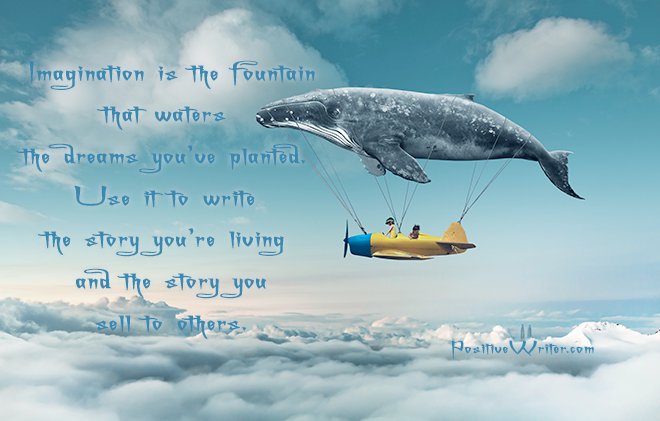
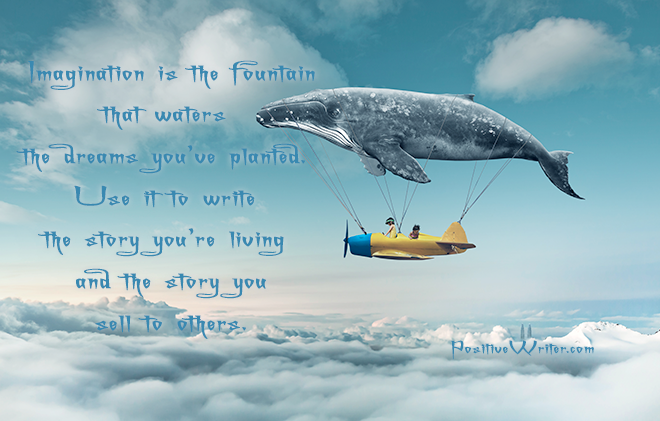
Imagination is the fountain that waters the dreams you’ve planted. Use it to write the story you’re living and the story you sell to others.

Why is this important?

Imagination is full of pictures. Vivid imagination has sounds, tastes, and feelings to go with it—but without pictures, it’s empty.

What do we use when we teach kids to read? Pictures. Lots of them. On every single page.

When you see it, you believe it.

No matter what you write, paint pictures. Facts without stories are dull.  Data without connection is meaningless.  Circumstances without a narrative are forgettable.

If you want to learn how to win people to your way of thinking, listen to a storyteller. Watch a TV program.  Study that commercial that led you to buy that course, that car, or even that brand of toothpaste.  What picture did they paint?  What pictures did they draw in your imagination?

Learn that and you’ll have a power that amazes you and your readers.

Start painting word pictures now

Word pictures are easier to paint than you think.

Here are some we use regularly in conversation:

  • Metaphors
  • Analogies
  • Anecdotes
  • Jokes
  • Comparisons
  • Allegories
  • Hypotheticals

Most of the time we do this when we’re trying to make something complex easy to understand. We want the light to come on for our audience so they can say, “Oh, now that makes sense.” We do that by comparing the unfamiliar with something we know like the back of our hands.

Once they see, they can agree.

Then they can decide to act on what they know.

Want to add power to this technique? Decide before you write a word what you want your reader to feel when she reads them. Do that, and the words will flow out of you like water flows down the side of a mountain.

I’ll leave you with an exercise to try next time you write. If you’re tempted to tell your reader what you want them to know, show them instead. Just describe what you see so your reader can see it, too.  Bonus points if you can evoke emotion with your picture.

Telling is as boring as listing your points on a PowerPoint slide. Would you tell people about your wedding without showing them pictures?

Imagination is a powerful thing. Use yours for good, and you’ll be an unforgettable writer.

Verified Evidence of the Paranormal in the Haunted Forest (Part 2)

Verified Evidence of the Paranormal in the Haunted Forest (Part 2)

written by Bryan Hutchinson

This is the follow-up post to the article (part 1) about the mysterious anomalies we captured in our photographs when we went to the locations where the events took place in my book, The Wee-Jees.

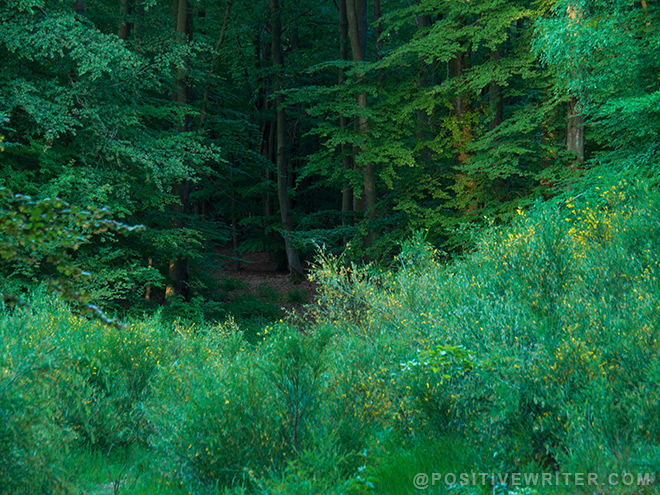
For those reading about this for the first time, The Wee-Jees is based on true events that took place in the haunted forest behind my childhood home. The forest was a scary place back when I was a kid, and, as Allison (photographer) and I recently discovered, it still very much is.

The Edge of the Forest

All photos in this post are actual shots from our trip to the haunted forest.

For Allison to verify the claims I wrote about in the book, which she hadn’t even read yet, is heartening because she was very skeptical about the events as I had explained them to her. It means a lot to me when someone who was so dubious ends up confirming the story with her own experiences and photographic evidence. It wasn’t part of the plan, but I’m grateful it happened if only to once again confirm that the forest is haunted and the Wee-Jees do exist!

I will warn you that this new book might be unnerving for some, so if you do not like reading and viewing anything about haunted locations with evidence, this book isn’t for you.

Click here to get your copy on Amazon!

How to Make Your Story So Compelling Everyone Will Want to Read It

How to Make Your Story So Compelling Everyone Will Want to Read It

written by Bryan Hutchinson

Everyone wants to know the answer to the kazillion-dollar question:

How do you get readers to show up, read your work, and become so invested in it that they can’t help but talk about it for days, weeks, and perhaps even years after they’ve read it?

*Near the end of this post, I issue a fun challenge to win an Amazon Gift Card.* 🙂

The first thing first is the most obvious, tell a good story.

Here’s the thing, though, lots of writers tell good stories, whether it’s a 2000-word article, a catchline, or even a book (especially a book).

And yet, a good story in of itself is not always enough.

After all, you’ve written good stories, and so have I, and yet we’ve both struggled to get readers to care enough to tell their friends and neighbors about what they’ve read.

What was missing?

What’s the special ingredient that gets readers to keep coming back, rereading it so often that even they are astounded as to why they can’t put your story down.

The Secret Sauce

You need a good hook: An Enticing Mystery, or Two, or Three.

It seems simple enough, right? Create a mystery—I mean, everyone loves a good mystery. And yet, it’s not that simple at all.

In fact, there is a mystery genre in writing, but if you’re like me writing a mystery story itself isn’t your cup of tea, and not all readers want to read a who-done-it. Then again, many love to read and write in the genre, just ask Watson!

That’s okay, if you don’t, your story could be a romantic thriller, or a romcom, or an epic fantasy story, or you could simply be trying to come up with the best slogan for a company that hired you.

All of these types of stories have room for a good mystery in them, questions the reader wants to answer, and when those questions are finally solved the reader receives such a powerful dopamine kick that it keeps them coming back to find out if they missed anything.

A good mystery or mysteries within your story is one of the key ingredients that make your writing must-read material. Readers love to question things. We, you and I, we are both readers too, we love to be fascinated and wonder about what was the meaning of this or that, and did that really happen the way you read it?

If you have a good story that the reader becomes invested in, you want to pull them in even further with mysteries they can solve (or think they can solve) and, more importantly, want to solve.

The Best Way to do This

One of the best ways I’ve found to create a good mystery readers are compelled to solve is to not make the hook so obvious. Sometimes this happens as a natural occurrence due to the story itself and sometimes you have to get creative and purposely add the elements of mystery.

Some Examples:

In my new book, The Wee-Jees, there are several mysteries tied into the story, some are obvious, and others are obscure, which when done right makes the story even more compelling.

Let’s start with the title: The Wee-Jees.

What are Wee-Jees? It’s a unique title because it sounds familiar yet is still so unfamiliar. What is it—where’d it come from? It’s a mystery, and I only reveal the answers within the story (or do I?).

This question of what the Wee-Jees are is even more compelling thanks to the subtitle of the book, A Ghost Story Based on True Events. 

Are they ghosts?

You’ll have to read the book to find out! So, already with the title, we have a mystery hook. But the title alone is not enough.

The Unintentional

There are many mysteries within the story itself, I am already receiving a ton of messages about chapter twelve, The Two Jakes. Some say what’s in that chapter is the spookiest thing they’ve read in a long time (in the best way possible).

But most people are emailing me a certain question about another event in another chapter, which I won’t reveal here. The answer, after all, is in the book, and in this case, like all good hooks, the answer itself is shrouded in mystery, too. It’s a great discussion starter when the book becomes the choice read in reader groups.

Several of the inquiries I’ve received have been unanticipated and have caught me by surprise, so parts of the mysteries were unintentional and are a natural part of the story. Good stories, especially those based on true events, will always have mysteries that develop within themselves. Some questions will never be answered.

Coming of Age and Love Story Questions

The story in my mind for 30 years wasn’t just about the strange events. My friends, and a young boy and girl’s first budding relationship, those stories get told because in order to give context to the otherworldly events I had to tell you, the reader, about everything that happened before, during, and after the events themselves.

It’s the context that makes this book so special and allows the already strange events to stand out in their absurdity. It’s also this coming of age story that really connects and raises questions within readers, especially those who see glimpses of their own childhood within my story.

These questions I could not anticipate as everyone sees a part of themselves somewhere in this story. So beware, memories can be triggered, much as Stephen King’s Stand by Me did for audiences in the 80’s.

How Many Are There?

A fun mystery in The Wee-Jees, which requires perhaps several rereads to solve, is:

How many ghosts are there?

How many ghosts are in the story? I’ll give you a hint, not all the ghosts in the book are obvious. There’s some sixth sense stuff going on that not everyone figures out after the first read-through, or the second, for that matter. Don’t worry, that’s not as big a giveaway as you might think–or is it? However, one Amazon reviewer (this is a clue) revealed some of the ghosts in her spoiler review (she guessing and she could be right).

Let’s have fun with this.

Enter to Win:

I tell you what, for anyone who has read The Wee-Jees, I’ll send you a gift if you solve the following mystery:

  • If you send me an email to bryanpositivewriter (at) gmail (dot) com correctly naming and/or describing all of the ghosts in the story, I will reply to you with a $50.00 Amazon gift card! You must name and/or describe ALL of the ghosts.

I’ll update this post here when the mystery has been solved! Send your answer to:

Take your time and read the book a few times before sending me your answer because I will only accept one entry per reader and only the first person who gets it right will win! The cut off to send your answer to me is Halloween, Oct 31, 2020!

The best part is that the book is just 99cents on Amazon until Midnight, 31 October! So it’s a small investment to read a nice little spooky story and have fun doing it. I recommend reading this one in bed, in the dark, with a flashlight the first time (if you dare).

It’s a short book, so surely you can read it several times before the 31st! Keep a pencil and notepad with you while you read it during the second (or third) time.

Conclusion:

All great stories do this, they have a good mystery, or several mysteries, layered within them.

Have you created intriguing mysteries within your stories? I’d love to hear about them in the comments!

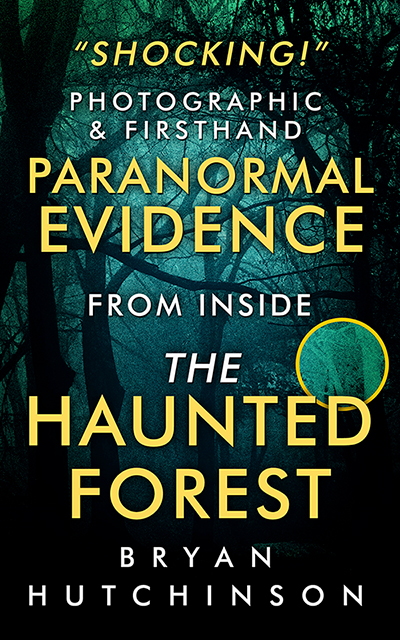
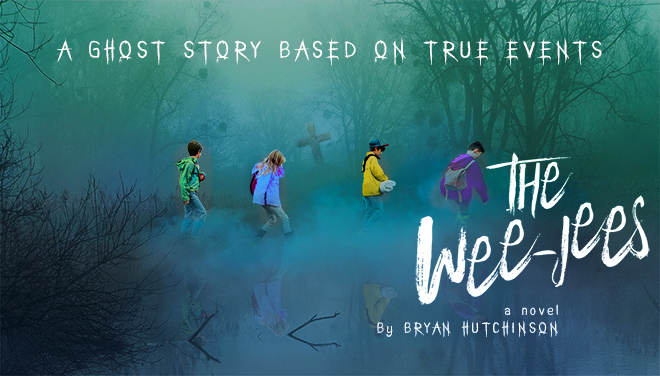
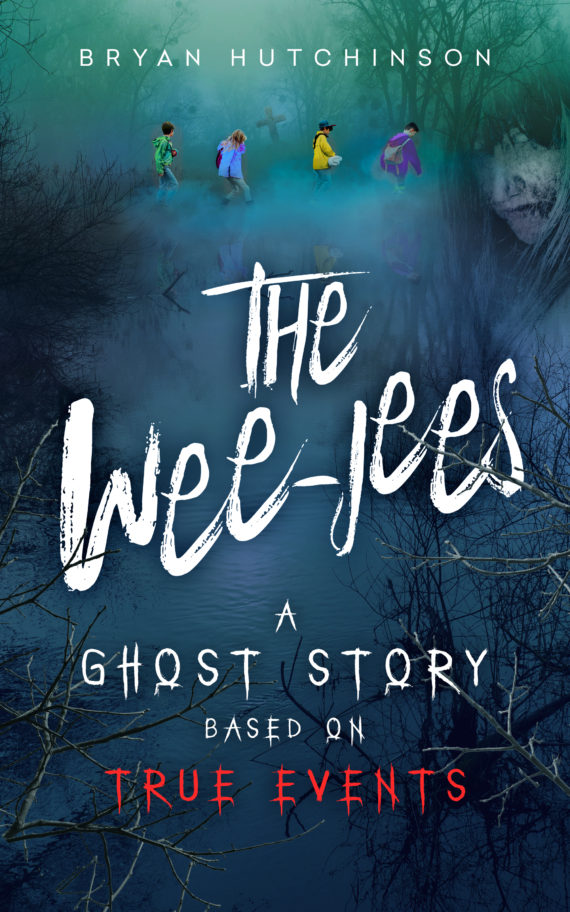
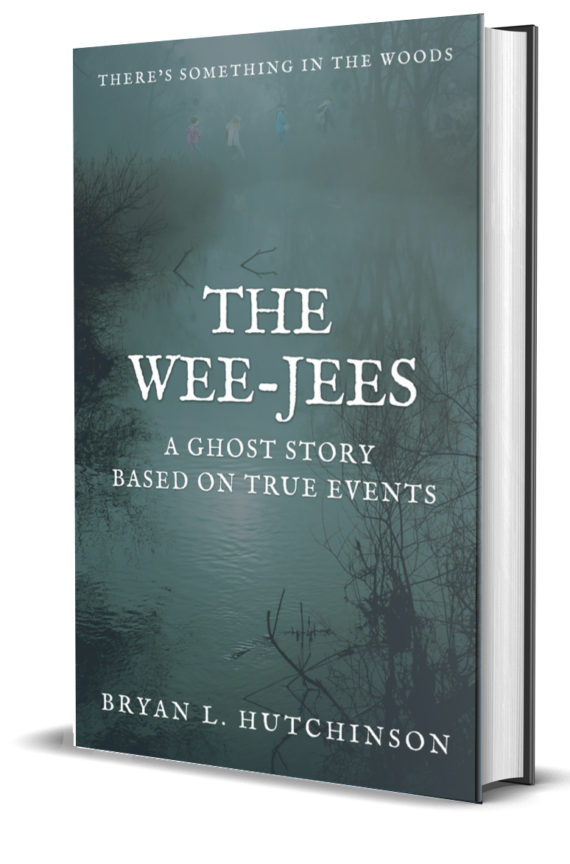
The Wee-Jees: A Ghost Story Based on True Events

The Wee-Jees: A Ghost Story Based on True Events

written by Bryan Hutchinson

I am very happy to announce the publication of my new book:

…

A group of friends trek deep into a haunted forest for what they expect will be a fun adventure. Instead, they end up in a terrifying game of cat and mouse with something otherworldly.

If you enjoy scary stories based on real hauntings this book is for you.

The Wee-Jees is very different from anything else I’ve written.

It’s a ghost story based on true events from my childhood when I lived near a haunted forest. I’ve written a dozen books and yet this is the book I’ve always wanted to write but eluded me for so long.

Now, with it finished, I am relieved, but also nervous with anticipation. I never wanted to scare anyone, but I have no choice. The story needed to be told.

I trust that you know the feeling because you have a story that needs to be told, too! I hope my story in today’s post inspires you to not only read mine but to write and share yours.

How I finally wrote the story that refused to be written (and you can, too!)

I wanted to write this story for many years, but something always came between me and the writing of it. In fact, about a half-dozen years ago I wrote a few chapters and sent them to my then editor, but she refused to finish reading them and instead insisted I talk about the events with a priest.

After my editor’s refusal, I gave up writing the story for several more years. I thought her suggestion to go see a priest was made in jest and she was merely saving me from rejection. It turned out that she was very serious, and her refusal to critique the chapters had nothing to do with whether my writing was any good or not.

Many other weird things happened whenever I tried to chronicle the story. Once, I somehow accidentally threw away a notebook filled with several chapters. By the time I realized what happened, the garbage collector had already picked up the trash and it was gone forever.

It’s as though the writing of this story was intentionally being stopped, and frankly, I believe that to be true.

I know how that sounds, but either subconsciously or in some other way, whenever I wrote about certain aspects of the story in detailed ways, I would stall and then stop writing about it, often for years.

For the longest while, I thought it was writer’s block, trauma, or my own fears of reliving those events, and although all those things are likely true to some degree, I believe something else was keeping me from telling the story.

In the moments when I doubted myself, doubted my writing, and even doubted my story, I told myself I can do this, I can write this story, I must write it, if not for anyone else but myself.

I wrote it. And if I could write this story, you can write your story, too. I promise you.

Although I’ve fictionalized parts of the story to respect the anonymity of my friends and fill in blanks, the experiences involving the paranormal are written with raw and unfettered honesty, I don’t hide what we experienced in any way.

I don’t want to reveal too much more in this post, as to not spoil it.

I hope that you take a moment to purchase it on Amazon, read it, and connect with me after reading it if you’ve experienced anything similar. I’d love to hear your story. I will soon set up another website for those who have experienced the unexplainable.

As a writer, you have to write your story, whatever it might be. My story happens to be a ghost story. What’s yours?

This is my story. I hope you enjoy it.

This is HOW I have SOLD THOUSANDS of Books! (And You CAN Too!)

This is HOW I have SOLD THOUSANDS of Books! (And You CAN Too!)

written by Bryan Hutchinson

Selling books is hard work, but there’s something that comes first and it’s even harder.

One of the most surprising things I’ve learned as a writer and as an author is that creating a team of writers is hard. And I mean, HARD.

But it shouldn’t be, and I’ll tell you why. This is important because if you want to sell thousands of books, you will need to team-up with your fellow writers, just like the best superheroes do when they want to accomplish big goals!

Everyone wants to get the word out about their books, articles, or blog posts, but when it comes to promoting someone else’s work, even our own, it’s a challenge to find the motivation, enthusiasm, and audacity, to do it.

Would you agree?

You might not think so, but even now when a lot of people are staying home and are looking for extra ways to create income to put food on the table, it’s still very hard to promote someone else’s work, even if they offer to pay you.

You can offer huge prizes, cash, gift cards, and even, magic pens, but it’s still very hard to get people to want to take part and join your team.

But why?

It’s an important question because one day you’ll have a book and you’ll want people to help you get the word out about it. And, for the most part, they won’t help. I don’t mean that to be derogatory, but it’s true.

It’s because we are writers in the 2000’s and we still haven’t realized times have changed and the only way to become “successful authors” today is to work together.

We are not enemies of the pen! Heck, we are not even competitors anymore. And we need to stop acting like we are.

The only way we can be successful today is if we unite.

Seriously.

We all need to build credit with our fellow authors because one day we are going to ask them to help us when we need it. One day we are going to have a book, or, a course, or something we need help getting the word out about and it’s going to depend on the credit we’ve built.

I LOVE working with other authors.

I have helped some, who would’ve in years past been my direct competitors, reach my audience and they’ve in turn helped me reach theirs. Just last month I worked with several bestselling authors in the writing genre where we ALL promoted each other’s books, together!

AND WE WERE HUGELY SUCCESSFUL!

We sold thousands of our books—together!

Believe it or not, there were several authors who were asked to join us but they didn’t want to promote someone else’s work. While every single person on the team saw their books reach #1 in several Amazon categories with incredible sales, there were those who preferred not to sell any books if it meant promoting others.

With that said, I’ll still invite them next time because I do not see them as rivals.

I have been part of several book launches, earning fun prizes for doing so, but not because I was especially great at it or that I loved the genre, or that I did anything special. No. Not really. All I did was read a book, decided if I liked it, and if I did (or didn’t), I shared what I thought about it on social media, even created a post or two, and a video or two for books I especially liked, and THAT was enough.

Why did I win prizes?

Because the reality is that only about 2% in entire book launch teams actually participate. So, I really didn’t have to do much, I practically won by default.

But I earned something much more valuable than money.

Those authors I’ve helped remember me when I need their help. They remember my name not because I’ve asked something of them but because I was there for them when they needed me. And not only was I there for them, I MADE A DIFFERENCE.

I. Made. A. Difference.

If you (yes YOU) are going to be a successful author today who sells lots of books, get readers for your blogs, or gets hired for your writing, you need to make a difference for others who could become YOUR allies and teammates.

Cold knocking on doors is practically impossible in today’s market, not when it is so easy for you to come in the side door, where the workers enter and make a difference immediately.

And it doesn’t make ANY difference if you’re self-published or traditionally published. You still need connections.

The secret in today’s market is becoming known.

And how do you become known? By being there and being part of teams, and if you do, people will remember you. I promise you this. This is so important. It could change your entire career as a writer.

Make a difference.

The reason I personally know people such as Jerry B. Jenkins, Jeff Goins, Seth Godin, Guy Kawasaki, (interviewed most of them) and so many others, is not because of luck, but because when they put out the call for help, I entered their side doors, the worker’s door, and I helped them. I didn’t just help them. You guessed it…

I MADE A DIFFERENCE

Jeff Goins still talks about how when he first created Tribe Writers that I was the first person on the TW Facebook Group each and every day helping other members in any way I could. Ask him and he’ll tell you.

I bet you’re reading this and thinking, oh well, you’re Bryan Hutchinson and you have Positive Writer, of course these authors would know you. Actually, NOT TRUE, I did not have Positive Writer when I first joined Tribe Writers. I created Positive Writer thanks to encouragement to do so while on Jeff’s team.

It’s not an accident. And it’s certainly not luck!

And the secret is so darn easy, it’s amazing not everyone is doing it:

Answer the call for help, show up, and do what you can–when you can.

Many paid me with rewards, but honestly, I would have done it for free. I was mostly in it for the chance to rub elbows, talk shop, and learn from them.

Do I know your name?

Should I? Think it over for a moment.

I’d like to say I should.

I’ve worked with Jerry B. Jenkins on a few of his projects over the last few years. He’s the author of the “Left Behind Series,” which has sold, oh something like OVER 70 MILLION copies. Love the series or hate it, that’s a lot of books sold! Nicolas Cage recently starred in a movie based on the series.

And people have asked me how I got Jerry B. Jenkins to guest post on Positive Writer. Honestly, it was easy.

Jerry put out a call for help a few years ago and I stepped up and I helped him. That’s how I got on HIS radar and now he remembers me. He even chose to read one of my books, “Writer’s Doubt,” and he liked it so much that he chose to personally endorse it, too. (Thanks, Jerry!)

Heck, Jeff Goins is the one who came up with the subtitle for “Writer’s Doubt: The #1 Enemy of Writing (And What You CAN Do About It)” Jeff didn’t even charge me for it. (Thanks, Jeff!)

This stuff happens. I promise you. It does. And it can happen for you, too.

If you have a chance to join another artist’s team today and help them, would you? Be honest.

If so, good, because that’s how you get on radars. Once you’re on someone’s radar, doors begin to open for you, and the world you thought was only meant for “special” people, suddenly accepts you in it.

You’ll have the chance to help your fellow authors and artists. You will. Sometimes they’ll offer you prizes and other rewards and sometimes just a few minutes of their time.

My advice is:

Don’t miss your chance. Just don’t.

Even if you can’t see how the connection will benefit you right now, trust that you can never have too many connections and you never know what the future will bring.

It’s easier than you think, trust me.

Build. Your. Bridges.

In fact, I am currently offering the opportunity for people to join my own book launch, maybe you’d like to join? You can join (click) here if you like. It’s only for the month of October, so hurry up, if you’re interested.

Just remember, if you want to become a successful writer, author, or any type of artist, your fellow writers are not your competitors—they’re your teammates, so join them!

If you’ve ever wondered how all those artists at the top became friends with each other and sell thousands of books, now you know. It’s not accidental.

Contest: If You Love a Fun Challenge as a Writer and a Reader, this is for You!

Contest: If You Love a Fun Challenge as a Writer and a Reader, this is for You!

written by Bryan Hutchinson

Do you like a good scary story? Is your favorite movie the one that keeps you on the edge of your seat wondering what will happen next? And after the experience is over, do you find yourself telling everyone you know how great it was?

If that’s you, I’d like to invite you to join The Wee-Jees book launch team! We’ve got plenty of tricks and treats for you!

So what’s in it for you?

Cash, Gift Cards, and fun, different ways to get ’em!

What’s this book about?

A group of kids decide to play with a spirit board. They get an intriguing message that leads them on what they believe will be a fun adventure.

But everything is not what it seems…

What starts out as harmless fun soon turns into a terrifying game of cat and mouse with something dangerous and otherworldly.

And if that’s not terrifying enough …. this really happened to me!

If you’ve ever been scared by something unexplainable, you’ll love this story.


(Photo credit: Diana Palacios)

The book is available on these sites:

Amazon

Smashwords

Barnes and Noble

Apple

The chance to win some pretty sweet CASH prizes!

Yes, you read that right.

Most book launches don’t offer cash prizes for participating. But I’m so confident you’ll love this book, I’m betting you’ll have a blast telling your friends about it!

So I’m backing that with the chance to win real cash (and Amazon Gift Cards) that you can spend however you like.

Here are the prizes:

  • First prize: $250, delivered via PayPal
  • Second prize: $150, delivered via PayPal
  • Third prize: $100 Amazon gift card
  • Runner up: 5 people will each win a $20 Amazon gift card (drawings)

And a SPECIAL BONUS PRIZE for the TOP 3 WINNERS:

Each of the top 3 will receive a half-hour video conference with me—live! We’ll talk about ANYTHING YOU WANT when it comes to writing. Pick my brain! No question is out of bounds. Want to know my writing process? How I publish my books? My launch strategies? Just want to chat about your writing and learn how to make it even better? It’s your half-hour—so you decide what we’ll talk about!

You don’t need a huge following to win

The #1 key measurement to this contest is who can find the most creative ways to get the word out about the book! 

#2 is participation in getting the word out during the launch. In fact, participation can turn out to be even more important as the goal is to a) inform as many people as possible about the book’s existence, and b) convince readers they should buy it and read it.

I want you to have fun with this. Do whatever you can with the time you have. A little enthusiasm goes a long way… and is highly contagious!

Here are a few ways you can help get the word out:

  • Film yourself talking about the book and share it on all your social media accounts. You can do it however you want—talk to the camera, add some photos and narrate them, or create your own graphic video slideshow!
  • Use iMovie and create your own movie trailer for the book. What would you see on the screen? Invite us to watch and share!
  • Read a short passage with your best scary narrator voice—with pictures inspired by the book—and make that into an original spooky video!
  • Write a book review on your blog or another platform that allows book reviews (follow each website’s own terms and conditions). Then tell us about it so we can share it!
  • Post your thoughts about the book and images of the book to your social media accounts. (Here are images you can use click here.)
  • Share blog posts I publish in October. (Everyone who shares a post should certainly enter to win the prizes! Why leave good money on the table???)

How will the contest be judged?

Glad you asked, the key to a good book launch is getting the word out. And that’s how the contest will be judged, on how contestants were able to get the word out using social media, traditional websites, blogs, podcasts, radio, and other unique ways you can think of.

Be sure to keep links and screenshots of your efforts to submit them to me by 3 November. Use this email address to send me your documentation: bryanpositivewriter (at) gmail (dot) com

There are no limits on how creative you can be.

If you need more ideas, look at what others have done in their book launches—and think about how you’d do it better. Your voice matters, and this is your chance to shine! And who knows? You might learn something so good you can use it in your own book launch. Then you can blog about it so others can benefit!

The Wee-Jees launches just in time for HALLOWEEN!

The official launch time frame is from October 1 to November 2, 2020.

Start thinking up some fun and creative ways to get the word out. The more fun you have, the more likely you are to win! 🙂

You can send me what you did for the prizes as of the 3rd of November. If you want to email me what you’re doing during the launch, by all means, please do!

Feel free to join the Facebook launch team group (click) here.

Here’s my email again: bryanpositivewriter (at) gmail (dot) com

To enter the DRAWINGS for the Amazon gift cards, go (click) here.

Please note that amazon reviews are excluded and cannot be included in any of the contests!

10 Habits to Becoming a Better Writer

10 Habits to Becoming a Better Writer

written by Bryan Hutchinson

For the past few years, my desire to become a published author has become topmost in my mind. Because of that, many of my action plans have revolved around improving my writing.

These action plans have included taking online courses, and I learned a lot from them. In hindsight, I noticed that it’s not the one-time thing that actually helped me become a better writer: instead, it’s the little habits that I didn’t even pay much attention to during the time.

So what are some of these habits that helped me to become a better writer?

NOTE: This is a guest post by Yen Cabag, she is the Blog Writer of TCK Publishing. She’s a homeschooling mom, family coach, and speaker for the Charlotte Mason method, an educational philosophy that places great emphasis on classic literature and the masterpieces in art and music. She has also written several books. Her passion is to see the next generation of children become lovers of reading and learning in the midst of short attention spans.

10 Habits to Improving Your Writing

Here are 10 habits that I’ve tested and proven to help anyone become a better writer:

1. Write even when you don’t feel like it.

We writers are quick to blame writer’s block when we are not in the mood to write. These past few months, I’ve tried pushing myself even when I don’t feel like writing, and to my surprise, after the first sentence or so, I can write!

I think this is one of the most important habits that any writer needs to develop, to push past the feeling of blah and just get writing.

2. Be OK with an unexciting first line—at first.

One of the greatest pressures that we writers face is the need to make that first line absolutely perfect. After all, doesn’t everyone tell us the first line has to hook your readers in, or else you’ve lost them forever?

Because of that, I find myself stuck whenever I can’t think of a great first line. One way that helped me move past this is to force myself to be OK with any old first line when I first writing. Then I just make a mental note to myself (or a literal note, typed in bold so I can quickly see it!) to edit that first line after I finish the entire piece, be it an article, a blog post, or a chapter in a novel.

3. Write first, edit later.

Another pitfall that many writers struggle with is the internal editor always forcing us to go back and fix things as we go along. This causes many delays, and sometimes even quenches the creative flow. I learned this important habit from several writing blogs, and I need to force myself to shut out the inner editor so I can just write my first draft and edit later.

4. Don’t be afraid to outline.

In the world of novels, two extreme writing styles are the plotter and the pantser. The plotter outlines everything, while the pantser just writes “by the seat of his pants.” I’m a fairly organized person, but I usually don’t have the patience to outline, and perhaps mistakenly think of myself as a pantser.

To test out this “theory,” in my current project of writing a nonfiction book, I tried outlining. To my surprise, it made writing the contents so much easier because I already know what I’m supposed to write about in every chapter!

5. Time yourself writing with undistracted attention.

I stumbled across this trick when I started writing for someone who asked me to use time-tracking software. Because I was timing myself, I was forced to focus on the task. Cal Newport, in his book Deep Work, explains how focusing on a task, instead of the constant multi-tasking that this information-rich generation does, actually helps us have more creative output.

I believe focused attention is one habit that writers really need to develop, and if it calls for a set time to do that, by all means, try it yourself!

6. Write different genres.

As writers, we may have specific genres that we enjoy writing about. But I’ve found that trying out different kinds of topics or styles can give a much-needed break, which helps recharge my writing all over again.

I suppose it’s strange, that having a writing career, I still write to relax!

7. Read, read, read.

Think of writing as exhaling, and reading as inhaling. Reading helps us writers feed on other people’s ideas and styles, and I believe it’s one habit that we need to keep cultivating.

For myself, I enjoy reading both nonfiction and fiction books, to relax after a long day of writing.

8. Practice touch-typing

I’m glad I already know how to touch-type, and relatively fast, so I can generally type out my thoughts as they come. If you don’t know how to touch-type, it may be a good time to learn how to do so, and keep practicing to improve your typing speed.

9. Keep learning.

Although I did say that the little habits I develop throughout the day gave me more results, as writers, we still need to keep learning. I’ve found that taking classes or finding a mentor to give direct feedback on my work is a great way to keep learning and improving.

10. Don’t despise small beginnings.

Lastly, one habit I need to keep cultivating is appreciating the little things. Are you “only” in Chapter 1? Don’t complain, instead celebrate it! The more I celebrate little victories, the more encouraged I am to keep going.

When you look back months, or years down the road, you will find that these 10 habits pay great dividends in helping you improve not just as a writer but even as a whole person.

Newer Posts
Older Posts

writers doubt book on writing

"Bryan's book, "Writer's Doubt," Will dispel any writer's doubt! Highly Recommended!" — Warren Adler, author, "The War of the Roses".
.
Writer's Doubt is an Amazon Exclusive Release.  Please note, all links to Amazon on this site are affiliate links.

Are You A Writing Warrior? If Yes, Join Us Now!

Hello! I'm Bryan Hutchinson, you might know me as the author of the bestselling book, "Writer's Doubt." On Positive Writer I help writers and bloggers do what they were born to do: Write and get attention! I'd love to keep you up to date and share my best tips with you:

Like Positive Writer on Facebook

SuperWebTricks Loading...

Become A Better Writer

Ready to improve your writing and your life?

Join The Art of Positive Journaling!


“I’m a fan!” —Jeff Goins, author of Real Artists Don’t Starve


  • Facebook
  • Twitter
  • Google +
  • Pinterest
  • RSS

Copyright © Bryan Hutchinson


Back To Top