Positive Writer
  • Inspiration
  • Writer’s Doubt
  • Free eBook Good Enough
  • Contact
    • Guest Post Guidelines for Positive Writer
  • Resources
  • Archives
  • About
    • The Wee-Jees Book Launch Team
      • Picture Files for the Book The Wee-Jees
    • Privacy Policy
    • Free Book
  • Inspiration
  • Writer’s Doubt
  • Free eBook Good Enough
  • Contact
    • Guest Post Guidelines for Positive Writer
  • Resources
  • Archives
  • About
    • The Wee-Jees Book Launch Team
      • Picture Files for the Book The Wee-Jees
    • Privacy Policy
    • Free Book

Positive Writer

Category:

Writing

Mine Your Emotions to Write Moving Fiction

Mine Your Emotions to Write Moving Fiction

written by Bryan Hutchinson

Showing emotion in characters—and evoking emotion in our readers—is a daunting challenge. It’s probably one of the hardest skills a fiction writer must master.

NOTE: This is a guest post by C. S. Lakin, an editor, award-winning blogger, and author of twenty novels and the Writer’s Toolbox series of instructional books for novelists. She edits and critiques more than 200 manuscripts a year and teaches workshops and boot camps to help writers craft masterful novels.

We writers want to think carefully about the emotions we hope to evoke in our readers. We want to think about why we want them to feel a certain way.

And just because I show children begging on the street and adeptly convey the emotions they are feeling in my scene, that doesn’t necessarily mean you, the reader, are going to feel compassion or anger or sadness. You might feel something else. Or nothing at all.

You can see what a ginormous challenge this is. But here is the secret to success.

Hemingway said, “Find what gave you the emotion . . . Then write it down, making it clear so the reader will see it too and have the same feeling as you had.”

Why does this work? Because all humans, for the most part, have the same emotional makeup. Behavior that scares, infuriates, humiliates, or alienates one person will generate the same reaction in others. You will never get 100% of your readers to feel exactly the same, but you can come pretty darn close if you are an emotional master.

Pay Attention to Your Own Emotions

Hemingway’s advice gives us the first step to learning how to manipulate reader emotions. In addition to examining how you emotionally react to things you see around you or on TV, pay attention to those moments when you feel strongly while reading a novel.

Have you ever read a passage in a novel that made you cry? Stirred up indignation? Real terror? I am often moved by passages I read in both fiction and nonfiction. Masterful writers can wrench emotional reaction from me even with random passages.

We’re told to get readers to bond with our protagonist within the first couple of pages, something few writers can do well. Yes, we might get readers interested in our characters and even riveted by their personalities and actions in the opening scenes, but do we truly care for them? Depending on your genre and story, you might not want readers to care for your protagonist all that much (at the start).

As we grow attached to characters throughout the reading of a great novel, we care more about them. And that makes it easier for emotion to be evoked in us. All along the way, a writer must carefully manipulate readers’ emotion, in a deliberate fashion, to try to get them to feel what he wants them to feel.

Factor in Action

When it comes to evoking emotion in readers, we go beyond the showing and telling of emotions in our characters. A huge element that sparks emotion in us is action. Watching what characters do, how they behave, the choices they make, the conversations they have—all can be potent triggers of emotion in readers.

When adept writers show action in a cinematic way, with characters acting, reacting, and processing amid sensory details and vivid description, readers are transported into a scene, as if they are there, living vicariously through the characters. Readers are willing and ready to suspend their disbelief and pull down their walls, making themselves vulnerable to an emotional experience that might be powerful.

Some readers read for the suspenseful ride. Like my husband and kids, they eagerly climb into seats on roller coasters—they’ll even wait two hours to experience a two-minute ride—just to get scared out of their wits. Some readers are perfectly fine crying, feeling miserable, aching in commiseration as they go on a difficult journey with a fictional character they love.

Why do so many people love to do this? I don’t know. I can only speak for myself. There is something wonderful, magical, and sublime about being made to feel deeply about something outside my normal routine, my normal life. Stories that remind me of what being human is all about, what love is, what loyalty is, what hope is, what being victorious looks like lift me up, confirm my humanity, bring deeper meaning to my own life.

So when you are considering how to move your readers emotionally, don’t limit yourself to showing emotion in your characters. Be sure to consider how you are presenting the action of your plot in ways that have emotional impact. And that’s really found in the plot itself.

What good is it for you to have empathetic characters with intense inner conflict and moral dilemmas, but all they do is sit around, drink coffee, text their friends, and worry about what to wear?

Situations and settings and sensory details have great potential to evoke emotion in readers, so push yourself to put your characters in places and predicaments that will set the stage for high emotional content.

Instead of thinking, “I want my reader to feel sad,” how much more masterful would it be to dig deep into the many emotional nuances we experience when any given event occurs.

Do what Hemingway instructed. When you feel something, write down what action took place that made you emote. Then dig into the emotions and learn not just why you feel this way but what exactly you are feeling.

What thoughts led you to those feelings? If you can nail the thoughts, which are words, you can put similar thoughts (words) into your narrative and character’s voice.

That’s the first step toward evoking emotion in readers in a masterful way.

Music to Stimulate Emotion

If you consider yourself an unemotional person, not used to tapping into emotional feelings, this aspiration to become an emotional master is going to kick your butt. I’ve had numerous editing clients tell me they really struggle with this. They say, “I’m just not the emotional, introspective type. I rarely get in touch with my feelings.”

Let’s face the facts: since readers read to care, to be moved, if you want to write the kind of novel that will move them, you must find those emotions within you.

Here’s one thing that might help: music.

I got the idea to listen to movie soundtracks from an author friend. He writes suspense, so he puts on suspenseful “theme” music when he’s writing.

I don’t know about you, but music is very powerful to me. It can evoke tremendous emotion in me. That’s why movies can move us in such emotional ways—they not only show scenes in which characters are emoting, there is a soundtrack that overlays, designed to stir emotion. Movies have such an advantage over books. Viewers see the action, which is much more powerful than reading about the same action. The visual is also enhanced with the auditory—we hear voices, sounds, textures that bring a scene to life. But music is something other.

Who can explain why certain musical scores make some people weep. Or want to cry out in joy? We can feel nostalgia, poignancy, love, peace, or awe when we listen to music. It’s hard to name the emotions we feel when we listen to music. Certain instruments might move us a certain way. I love hearing YoYo Ma play cello. Some are moved by opera. Or a sweet folk song.

The first time I heard Pharelle Williams’s song “Happy” on YouTube, I got so happy I started dancing around the house just like all those people in the music video. That song was so powerful, that people all over the world got hooked on it. Even Oprah had Pharelle on her show to talk about that one song. (If you haven’t seen it, take a minute and watch. It shows ordinary people of all ages, races, classes, stature dancing to the song in a wide assortment of locations.) It also inspired people all over the world to record themselves and others moving to the song.

Music is powerful. Music and dancing are universal. Joy is something everyone wants to feel. Emotion is powerful, infectious.

We also bring our past to our response to music. What are your favorite songs from when you were a teen? Music sparks intense memories. When I hear certain songs, I’m instantly transported to specific times and places in my life. Not only that, I can almost taste and feel as if I were back there, thinking and feeling the way I did when I was fifteen or twenty.

Music sparks memory. Memories spark emotion. Emotions lead to more thoughts and memories and more emotion.

If you know you need your character to feel something and you’re not sure how to tap into that feeling, try to find some music that will take you there. Find some music you already know. It could be a song or a movie soundtrack.

When you listen to a piece of movie music and know the scene it’s from, that can produce a strong feeling in you, especially if that scene moves you in a big way. I have a playlist of hours of soundtrack music. And I often chose a particular piece to listen to when I’m writing or plotting a scene in which I need to feel something particular. I may not be able to name the emotions, but I know what feeling I’m searching for.

Music can free you up. Bypass your resistance or writer’s block. If you need to write an exciting high-action scene and you put on music that is exciting and stimulating, it can get your creative juices flowing and drown out your inner editor.

It doesn’t take many words—a few bits of imagery, an ominous line or two, carefully chosen verbs and adjectives to evoke emotion. I urge you to pay attention to the small details, for they often create the biggest emotional impact.

And always ask yourself when reading moves you: What am I feeling? What made me feel this way? How did the author do this magic?

By getting into the habit of mining your feelings, you will be well on your way to becoming a master of emotion in your fiction writing.

Want to learn how to become a masterful wielder of emotion in your fiction? Enroll in Lakin’s new online video course, ‘Emotional Mastery for Fiction Writers,’ before September 1st, and get half off using this link!


Why Writing in Isolation is Good For You

Why Writing in Isolation is Good For You

written by Frank McKinley

You’ve probably heard that writing is a community affair.

Well, it is, and it isn’t.

Sure, if you want people to read your work, you’ve got to know what they want. So you visit the blogs on your topic and start snooping around. You might even look at the comments and see what questions people are asking. Who knows? You could be first with the answer nobody has given.

Then you run your idea by a few of your closest friends to see what they think. It’s kind of like getting pre-approved for a loan at the bank. It seems like a waste of time to go fill out papers for a whole afternoon if they’re just going to say no, isn’t it?

So you seek permission to write what’s on your mind.

At least you do if metrics matter more than free expression.

What if you go and hide to write?

The obvious way to hide is to sit at your desk and cut off all contact with the outside world.

No social media.

No email.

No notifications of any kind.

Can you do it?

Sure, you can. Just turn it all off. Besides, it will still be there when you get back.

But what if you have an appointment?

Work around it.

Set office hours. Let people know when you’ll be available so you can devote your full attention to them. And let them know when you can’t by making yourself unavailable.

Trust me, they’ll thank you for it.

There’s something else you’ll turn off while you’re writing. It’s so important it’s easy to overlook. But if you do, it will ruin your work.

What is this poison?

Opinions.

Ask other people what they think before you put words on paper. Ask them in conversations beforehand. But once you enter the writing chamber, no one else matters.

Writing time is your time

When you’re in your writing space, it’s sacred. It’s not to be interrupted by second thoughts, the phone, or anything that can wait.

Especially other people’s opinions.

When you’re in your writing space, it’s sacred. It’s not to be interrupted by second thoughts, the phone, or anything that can wait. Especially other people’s opinions. Click To Tweet

You’ve already floated the idea by a few people. They had their chance to agree or object then. Don’t leave the door to criticism open when you’re creating. Just open the spigot and let it flow.

Besides, you’ll edit later.

But not until you’ve had time for your draft to simmer.

Some use the term “free writing” for vomit drafts of all types. Why? Because you’re ignoring all the rules. Spelling. Grammar. Typos. Whatever.

You’re giving your voice free rein to say whatever it will.

Don’t worry about being offensive, wrong, or sloppy. Your prime concern is to get your deepest, most unreserved thoughts out so you can mine them for the gold inside.

That may mean you move a little dirt later. But so what? You’ve got to put the dirt there to move it. It’s just part of the process.

Keep the door closed while you edit

When it comes to startups, business expert Seth Godin says you should thrash early.

What this means for you as a writer is you get all the input you need on the front end. You research, then you write. You take a break, then you edit. Find the changes you need to make on the first swipe if you can. After that, go with it.

Too many changes dilute your writing’s power.

Don’t smooth off all the edges. You don’t want dull words competing with edgier ones. Your edges will help you stand out and will show your genius in all its imperfect glory.

Worried you’ll be criticized? Good. That means you’ve made an impact. No criticism means no one cares. And who wants that?

Keep the door closed to other eyes until you publish. The only exception to this is if you hire an outside editor specifically to make your piece the best it can be. Otherwise, use your best judgment. Set a time limit that fits the work you’re doing. Then share it with the world.

Open the door when you launch

You do this by allowing comments on your work.

If comments bother you, just turn them off. Seth Godin does this. And he’s still as popular as ever. You won’t go to writer’s hell if you cut off comments.

But if you’re growing, you might want to have a chance to talk with your readers.

Answer their questions. Respond to their observations. Ask them about what they’re working on, and offer advice if you can (and you sense that they might want it).

Generosity is a great community builder.

You might pick up new readers, customers, or even a client or two.

Here’s something not many talk about. When you talk about a finished work, rather than one that is still in progress, you’ll gain more confidence. Why? It takes guts to finish something. Every time you do, you get a little stronger. You learn more. And your writing time becomes more and more effective at bringing out the genius inside you.

It takes guts to finish something. Every time you do, you get a little stronger. You learn more. And your writing time becomes more and more effective at bringing out the genius inside you. Click To Tweet

Create your own writing sanctuary

You know your space needs to be quiet and free from distractions.

Now let’s take it to the next level.

Do you thrive with background noise? Or do you prefer total silence? Will you listen to music or binaural beats?

Will you have anything to drink? Water is good. I like coffee also. Stay hydrated and you won’t be distracted by hunger or undue weariness.

You also need a timer.

When you’re sitting at your desk for what might be hours, you’ll wear your eyes out if you don’t get up and move around every 25 minutes or so. Take a 5 minute break then get back to work. After 4 sessions like this, take a longer break (at least 15 minutes).

Make sure you don’t cheat and sneak some work in while you’re resting. The only work you can’t get out of is being alone with your thoughts. The forced breaks might just fill in gaps that would remain if you pressed on full steam ahead.

You might know this as the Pomodoro Technique. I’ve used it faithfully for years. I thought at first the frequent breaks would mess with my flow. But they actually made me more productive. When you rest before you get tired, you’re more eager to get back at it.

Here’s a bonus from Julia Cameron. Celebrate your wins by going on an Artist Date with yourself. It can be whatever you want. A walk in the woods. A bowl of ice cream. A trip to the coffee shop. Or maybe you just buy (or make) a trinket to mark the occasion.

When you cheer yourself on like this, you’ll find the will to press on when it counts.

How does isolation help you write better? Share your stories and strategies in the comments. I’d love to hear what works for you! Have questions? Feel free to ask. We’re here to help you make your writing dreams reality.

Why Every Writer should Eat Healthy and Exercise If They Want to Create Their Best Work

Why Every Writer should Eat Healthy and Exercise If They Want to Create Their Best Work

written by Bryan Hutchinson

Over the past few years, it’s been very difficult for me to concentrate on writing. I thought it was merely because I was getting older and perhaps a bit burned out and maybe a little disinterested, but I was wrong. Very wrong.

And you know what? You might be in the same boat I was in and not even realize it.

Whatever life situation you’re in right now, if you have moments when you feel underwhelmed, unenthusiastic, and way beyond just tired, unable, and seemingly incapable of creating your best work – for that matter, or to even try your best, and you’re more likely to give up, hit the sofa to eat and watch a movie instead of writing, you are not alone!

5 years ago I quit smoking, finally. Halleluiah! It was the best decision of my life.

But then something happened, I started to eat. When I say eat, Lord, you don’t know, I started to eat E-V-E-R-Y-T-H-I-N-G. I couldn’t pass a fast food joint without getting a burger (maybe 3 or 4) and fries, I couldn’t pass an ice cream stand without at least getting a multi-scooper on a sugar cone!

It was a disaster.

Within just a few months of quitting smoking I put on 10 pounds, then 20, and then 30. And you know what, I gave into it. But after a while I noticed it wasn’t just that I was gaining weight, I was getting tired faster, wanted to sleep longer, and I just didn’t have the desire to write all that much anymore.

Have you ever gotten instantly depressed merely from looking in the mirror?

I did. And it didn’t simply go away when I stopped looking. It lasted, and crazy enough, it made me eat more.

People kept saying the weight you put on after quitting smoking eventually goes away, like magic. Let me tell you two things, it doesn’t just go away and there is no eFF’ing magic to it! Zero.

I haven’t written all that much over the past three years. It’s been a struggle to sit down, face the keys and type anything, much less words that matter. I got fat and with each pound, I lost more and more of my drive.

New Flash: According to the Harvard School of Public Health, weight gain impairs physical functioning, reduces quality of life, and is associated with poor mental health. And now, friends and neighbors, I can personally confirm this! Or, better said, no shit!

Most of my life I’ve been a rather small guy, slim, 130 pounds soaking wet, with a size 29 waist. When I went into surgery for my hernia a while back, I weighed in at 200lbs! I’m not a tall guy, so 200 pounds is a big deal for me. It was a shock.

About 4 months ago I went to the doctor because I felt pulling in my chest after I ran upstairs. It freaked me out. The doc did an EKG and it didn’t come back all that great.

Let me tell you when you get EKG results that aren’t “good,” everything changes.

I could tell something was wrong when the nurse was finished and she hurried out with the results with a very concerned look on her face and then the doc came back in a minute later seriously looking over the results. I started getting scared.

Apparently, there was an anomaly in my results, I won’t go into the diagnosis in this post, but I will tell you this, from that day forward I changed my eating habits overnight. For 3 years I had wanted to change my diet, but it had been damn near impossible. However, with this new motivation, I changed my choices of food without a second thought.

Isn’t it strange how something can suddenly be so life changing? We can struggle for years and then something snaps and the change becomes instant. I wish we could do this without extreme crises.

This isn’t the first time medical results caused me to change instantly. In fact, my doctor’s warning about emphysema caused me to quit smoking from one minute to the next. I had tried to quit for years and his lab results caused me to quit instantly. It’s sad that it takes such dramatic life and death warnings to get me to choose to stop killing myself.

I’m sure I am not alone, so take it from me, don’t wait if you find yourself in unhealthy lifestyle situations. But that’s the thing, isn’t it? Waiting isn’t the problem. It’s the sudden clicks in our heads that get us to take action, but until the buttons are pushed, change seems impossible.

I used to think people overweight simply didn’t want to lose weight. I thought it was a choice. Same with smoking, but how did that work out for me after so many years doing it? Not great! Teeth problems, breathing problems, and so many underlying issues―many that I might not even know about yet. God willing, my body will heal itself.

Weight is even worse because it’s not like you can only stop eating―you have to change nearly everything you do eat (or, at least I had to).

And let me tell you, no matter how much smoke shaming, fat shaming, whatever-you-struggle-with shaming, and yes, even worse, self-shaming we have to contend with, none of it compels us to positively change. All the shaming just makes it worse. I wish it would stop.

Non-smokers, slim people, and anyone who thinks they know better and have to be an ass about it, stop it. One day, there will be something someone’s going to shame you about (if it’s not happening already).

Instead, consider helping, supporting, loving, and just plain caring. Or get out of the way and leave well enough alone.

Without the need to shame anyone, please know that change is possible. I did quit smoking. I did lose weight―40 pounds!―(finally), and I am making better lifestyle choices. You might not be a smoker and you might not be overweight, but there might be something causing you distress and self-harm. Know this: Positive change is possible.

Know this: Positive change is possible. Click To Tweet

Major Changes

These are the major changes I made:

1) Stopped eating junk food and limited sugar intake!

The first thing I did after I got the results of my EKG is I committed in my mind that I was not going to eat junk food anymore. I also stopped eating “added sugar,” in other words if it’s not a natural sugar, I don’t eat it.

This may sound like a small undertaking, but truth be told, I ate fast food and drank soda daily! I’m an on the go person and fast food fit my lifestyle. This was one of the biggest changes I’ve ever made.

2) Stopped eating white bread, rice, and pasta.

Actually, I have practically stopped eating bread altogether. I do eat one slice of gluten-free sunflower seed bread in the morning with a slice of cheese. I love rice and would eat it by the bowl, especially when I would get Chinese food to go. Spaghetti was another quick meal I would frequently make.

This might surprise you, but a study in 2015 published in the British Journal of Nutrition studied people who were split into two groups. One group lowered their whole grain bread consumption and the other group lowered their white bread consumption. The group that ate less white bread in their diet lost weight, in particular, belly fat. To add to this, I’ve lost 70% of my belly fat in the last 4 months!

3) Started eating salads for lunch and stopped eating large meals at night.

In the past, I would have a complete junk food lunch, and later, at home, I’d eat another full meal. The sad thing is, most of the time I wasn’t even that hungry in the evening, but I grew up with dinner at 5 and I’ve kept to that regardless of how much I had already eaten for lunch. Now I usually have a light bowl of soup in the evening.

4) Stopped trash snacking.

When I would sit in front of the TV or when I was working on a writing project I would frequently eat cookies or chips (or another trash snack), and often I’d have a little dip to go along with the chips. No more!

5) Replaced trash snacking with plain or lightly salted popcorn.

Popcorn is actually a low-calorie healthy snack, when, and only when, we pass on all the other toppings. Lightly salted (if you’re not prohibited from salt) and perhaps a little parmesan cheese, but all that other stuff, like butter, is a no-go. The great thing about popcorn is that it fills me up crushing the munchies that used to do me in.

If you like popcorn, the best option is to air pop it yourself. It’s very easy, simply put the popcorn kernels in a brown lunch paper bag and fold the top over twice to ensure it’s closed. Microwave on high until the popping has about a two-second gap in it, 1.5-2.5 minutes depending on your microwave. Dump the popped popcorn into a large bowl, salt as you want it, and enjoy! It’s cheaper and a lot healthier than pre-bagged microwave popcorn.

Other snacking I enjoy are grapes, nectarines, apples, and other fruits.

Here’s a quote I love from Jim Rohn:

We’ve all heard the expression, ‘An apple a day keeps the doctor away.’ Well, I’ve got a question for you: What if it’s true? Wouldn’t that be easy to do-to eat an apple a day? Here’s the problem: It’s also easy not to do. – Or, the guy messed up the saying, the guy says a Hershey bar a day… No! It’s not a Hershey bar, you’ve got to be smarter than that.

 6) Started exercising.

I started with some light aerobics to music in the mornings. I made it fun by treating it like a dance and not going too serious right away. At first, I only did aerobics for about 15 minutes, but now I do it from 30 to 45 minutes to 1 hour, depending on how much time I have available. I’ve also learned that in order for exercise to be effective, 5 hours a week is the optimal amount of time that should be spent doing it. I make sure I get my 5 hours every week!

I thought I would hate exercising, but after doing it for several months, I don’t know how I ever lived without doing it. It makes the entire day so much better.

Feel Profoundly Better

The above list might seem easy to some, but let me tell you, these are major, even dramatic changes I had to make. The improvement in how I feel, how I can focus and concentrate are nothing short of profound. I find myself writing again, heck, later this year I will publish a new book! Getting your blood flowing and having nutritious food in your system increases motivation and decreases procrastination. And, let me tell you, I was a world champion procrastinator!

I hope the changes save my life. I want to live to be 100! We live in a fast food world and we are in a century of ever-increasing productivity and go-go-go. The problem is the human body wasn’t made to be under so much constant demand and live off of processed food which provides practically no nourishment.

Whole foods rich in natural nutrients have changed my life.

I do my best to stay away from processed foods. I strive to eat what my body can actually use. For example, my body can get the most out of fruits, which do contain sugar, but that’s no excuse to eat a candy bar―which also contains sugar. The difference is my body can use the vast nutrients found in grapes and other fruits, but candy bars are useless with the exception of adding to body fat and adding other dangerous ingredients to my body.

Of course, you can overdo your sugar intake by going overboard on grapes, but under all circumstances, I still prefer them over cookies, chips, and candy bars.

I learned the hard way if you want to feel right – you’ve got to eat right!

If you want to feel right - you've got to eat right! Click To Tweet

I love writing. I love creating. I love living. I’m going to eat and drink accordingly going forward. I prefer to eat healthier and exercise rather than feel like crud every day and not write the way I want to write and be the person I want to be, healthy and energized.

Every writer, artist, and creative, should consider eating healthy and exercising. You won’t just get back to creating your best work, you’ll feel much better too!  I promise.

People have noticed my weight loss and have especially noticed I’m more upbeat and animated and that’s so rewarding to me for others to acknowledge my efforts to overcome my personal struggles. Several have asked me sincerely how they too can lose weight and/or deal with their various struggles, and at first, I wasn’t sure how to answer, but after thinking about it, allow me to offer these steps as suggestions:

1) Make a conscious decision.

Before I quit smoking and before I started to eat better I had already determined that I wanted to do those things. Although both changes I made in an instant manner due to the doctor scaring the shit out of me, the fact that I wanted to do these things was something I had already decided, so the actions were in line with my will.

Now here’s the thing, I wanted to eat and live healthier not just so that I would feel better or that I would lose weight, I ultimately wanted to live healthier because my heart needs me to and I want to live longer.  Feeling so much better and losing weight are two major side effects of this new lifestyle.

I didn’t say to myself, I’m going to start losing weight tomorrow. What I said to myself was, I’m going to consciously choose better foods and stop eating junk food! Period. And, thankfully, I did that.

The conscious decision was key. If you’re not sure or half-ass about whatever you want, change will not happen. I know, because all of my previous efforts failed due to indecision.

2) Make way-of-life changes.

Fad diets, crash diets, 6 week or 6-month diets, are, for the most part, bullshit! Seriously, why go through so much effort simply to go back to the way things were when you were not as happy, when you didn’t feel like you wanted to feel, when you didn’t look like you wanted to look, and when you weren’t being the person you wanted to be? Think about it.

Diets are temporary, that’s why we so often say they fail because we expect the results to last after we stop them. However, the good news is that when you make a lifestyle change, meaning you change the way you live your life, such as your eating habits or any other habit, you make a commitment to yourself forever. Lifelong commitments last. Temporary changes, don’t. You would think this would be a no-brainer, but most all of us fall for the idea of diets.

What I discovered is that when I changed my eating habits at first the food was different and it didn’t necessarily taste as good, but now, months later, I love what I am eating and it tastes far more delicious and nutritious than all the junk I had been eating. Processed foods have so many additives and crap in it that we don’t even know what it’s like to not eat them.

Once you get used to natural whole foods, you discover what you’ve been missing. Commit to lifelong change, my friend.

3) Get out of your own way.

What I mean by that is we are a results-driven society, but this drive hurts us when we are trying to hurry the human process along. Once you start to improve, let’s say you start to lose weight as I did, you might get excited and overeager for the process to hurry up and you begin to check your weight every morning. I personally think this is a fallacy and is more likely to lead to failure.

The human clock works on its own time, there’s only so much you can do to hurry it along. Waking up in the morning expecting to have lost 5lbs because you starved yourself the day before is not just impossible, it’s dangerous.

If you’re doing the right things, such as exercising and eating the right food for you, the results will eventually be obvious, but you shouldn’t get so impatient that you try to hurry them even more. Trust that you are already doing what you need to do and forget about your weight for a while, just let it happen. It will.

I don’t know how many people ask me about my weight daily. What’s the number today? They look at me strangely when I say I don’t know. I check at the end of each month, but not day to day.

4) Do what’s right for you.

This is so important. What I eat and do, might not be right for you. I enjoy aerobics in the morning. It reminds me of doing martial arts in my childhood, so now that I’m into it, I am even getting a little back into martial arts. I discovered the other day I can kick again!

What’s your thing? What would you like to be able to do again?

We are also lucky that today, even better than just 10 years ago, there are more healthy choices, premade salads, fruit bowls, and other ways of eating healthier. It’s not as challenging. Take advantage of it! If that’s your thing.

Ask yourself these questions to help motivate yourself to get started:

  • What do I want?
  • What would I enjoy most if I were healthier, more energetic, smarter, not procrastinating, smoke-free, you pick.
  • How can I do it?
  • Who can I ask for help or advice?

Last Word: CHANGE Is HARD – But Can Happen In An Instant!

Everyone makes the mental changes they need to in order to change in an instant. However, until that instant comes, whatever may cause it―be it a decision, a diagnosis or just the fact that you’ve had enough of whatever it is already― real change can’t and won’t happen.

We can want and even try for years to do something, to change something, but it’s not the years that make the difference, it’s the instant the mental change is made within you! I can’t make it for you, nobody, no matter how hard they try, or how much they preach, can make this change happen for you. Only you can.

After the EKG I could have continued my unhealthy lifestyle and I would have paid a high price, but in an instant, I made a mental change that may have saved my life! Yes, it was the results of the EKG that motivated me to change, but why? Because it was a trigger.

What I have learned about making real changes is that we have to find out what our triggers are first. For example, when you become attracted to another person you go out of our way to discover what they like and don’t like so that you can best appeal to them via their triggers. This is basic human nature, and therein is the answer.

Instead of discovering what the triggers are for other people, find out what your own are and use them to create change in your life. What is powerful enough to motivate you to change in an instant? You know what it is. Trust me. My health was most important to me when it came to smoking and weight. What’s most important to you?

Any questions? Feel free to ask in the comments.

Want to be funny? Here are 5 simply ways to mix humor into your writing!

Want to be funny? Here are 5 simply ways to mix humor into your writing!

written by Bryan Hutchinson

Creating content that puts smiles on the readers’ faces can be very challenging. Not only is humor very subjective but you also need to know how to use just the right dose. This doesn’t mean that you are facing an impossible task. It means that you’ll need to add a bit of strategy to your creativity.

Depending on the type of content you want to produce, there are different ways of incorporating humor. For some inspiration and motivation, the following five ways of incorporating humor in your writing will give you some helpful ideas.

Note: This is a guest post by Adriana Veasey, she is a writer and editor at Studicus.com. Writing is more than just her job, it is her passion in which she invests all her time and creative energy.

How to do it without overdoing it?

What you need to understand about humor is that not everyone finds the same jokes funny. That is actually not your problem, but what can be your problem is if you cross the line and offend your readers.

So, how to avoid such an inconvenience?

Here are some don’ts that you should keep in mind before you risk getting chased with pitchforks and torches:

  • Racism
  • Sexism
  • Putdowns
  • Dark humor
  • Corny, used-up jokes
  • Bashing your competition

Now that we know what type of humor should be avoided, let’s get to the useful tricks.

1. The joke is on you

Show your readers that you are not a sensitive little flower and that you can handle a good joke. According to a study (HSQ; Martin, Puhlik-Doris, Larsen, Gray, & Weir, 2003), people who make themselves the butt of their own jokes actually demonstrate greater levels of happiness and self-assurance.

Self-deprecation is a safe choice, meaning that you won’t risk offending anyone and you’ll portray yourself as a confident individual.

Who knows you better than yourself? Take all those funny and cringy stories, stereotypes, and flaws and use them in your writing.

There is more to it than just making people laugh by joking about yourself. Readers will be able to relate and create a connection with you if you open up. It shows that you are honest and willing to accept your flaws.

Of course, if you don’t feel comfortable with this type of humor don’t force it. It is important that you truly feel good about yourself and are ready to share with the world some of your embarrassing stories and insecurities.

2. Are you ready to compare?

Those of you who have read Robert Schimmel’s book Cancer on $5 a Day (Chemo Not Included) might have noticed the following part:

This stupid hospital gown is riding up my ass. I try to pull it down and it snaps right back up like a window shade. I cross my legs and suddenly I’m Sharon Stone.

When using comparison it is crucial that you use situations that are generally known or popular. Like Robert did with Sharon’s famous scene in Basic Instinct.

Writers are used to using comparisons and metaphors in various styles so this shouldn’t be a difficult challenge.

Just think through what depicts the situation that you want to describe. Is it painful, sexual, embarrassing? Then brainstorm and wait until something valuable comes to your mind. It should just come instinctively.

3. Get playful with words

Jazz up your writing with simple word twisting or word tweaks. Whether you want to use the already existing ones or make something up, it is up to you. The choices are endless.

For example, what do you find to be funnier skedaddle or hurry? A promiscuous man or a mimbo?

Using simple but funny words will give a humorous tone to seemingly ordinary sentences.

You can even make some of your own word combinations. Go wild and come up with new words that can add that something extra to your writing. Who knows, maybe it will even end up in a dictionary one day. Dare to dream!

4. Go big or go home

A little exaggeration can’t hurt anyone, can it? This has always been a popular technique among comics and humor writers and for a good reason.

There are writers who base their work on exaggeration. Just look at the work of Dave Barry, a Pulitzer Prize winner for humor writing. He is the master of exaggeration, but don’t take my word for it. Let his work speak for himself:

  • Eugene is located in western Oregon, approximately 278 billion miles from anything.
  • I have been a gigantic Rolling Stones fan since approximately the Spanish-American War.
  • If you were to open up a baby’s head – and I am not for a moment suggesting that you should – you would find nothing but an enormous drool gland.
  • It is a well-documented fact that guys will not ask for directions. This is a biological thing. This is why it takes several million sperm cells … to locate a female egg, despite the fact that the egg is, relative to them, the size of Wisconsin.

Is this enough to convince you?

5. Get down to details

Besides helping the readers to really picture what you are describing, including all the small details can sprinkle some humor on any situation.

Think about these two examples:

  • She was holding an old, rag doll.
  • She was holding what seemed to be an old, rag doll. However, it was more like a yellow ball of fabric with two black-ish patches for the eyes and a crooked smile (maybe it had a stroke, who am I to judge).

The more details you give, the scene will look more absurd and comical. Really picture all the little things that make that specific thing what it is.

I’m not saying that generalization can’t be funny, but when you really get down to specifics that is when things get spicy.

Joke ahead!

Hopefully, the above-mentioned tips have given you some inspiration and ideas on how to add that humorous effect to your writing.

It is up to you in which direction you will go, but as long as you don’t hold back, I’m sure that you will manage to create something great and worthy of every laugh.

What’s the funniest piece you ever wrote? Is it published on a website or on your blog? If so, link to it and share it with us in the comments below!

How to Refine Your Raw Writing Talent – by Jerry B. Jenkins

How to Refine Your Raw Writing Talent – by Jerry B. Jenkins

written by Bryan Hutchinson

Discouraging, isn’t it?

You write a few blog posts and friends sing your praises. You dream, Maybe I’ve got what it takes to score a publishing deal.

But then you run your idea and your samples past an agent, an editor, or a published author, and the music screeches to a halt. You interpret their “meh” as a scathing critique and you’re rudely awakened from your dream.

Special Note: This is a guest post by New York Times Bestselling author, Jerry B. Jenkins. Jerry’s one of the most successful authors of our time with over 70 million copies of his books sold. Visit: jerryjenkins.com

Unfortunately, I’ve seen it over and over.

Writers ask me for feedback. I believe they want real input, but when they see my suggested edits, their faces fall.

I know they were dreaming I would say, “Where have you been? How has a major publishing house not found you yet?”

They weren’t really looking for input—they were looking to be discovered.

You might have a boatload of talent—enough to tell compelling stories in fresh ways. But if you can’t accept criticism from those in the business, you’re not going to succeed.

I’ve written and published 195 books, including 21 New York Times bestsellers, yet I still need fresh eyes on my work. And I’ve had to become a ferocious self-editor.

Writing is a craft.

That means you must build your writing muscles and learn the skills.

Writing is a craft. That means you must build your writing muscles and learn the skills. Click To Tweet

Regardless how talented you think you are, writing takes work. Many talented athletes never become pros because they believed raw talent alone would carry them.

That doesn’t have to be you, as long as you cultivate your skills.

3 Ways to Hone Your Talent

1. Read, Read, Read

Writers are readers. Good writers are good readers. Great writers are great readers.

Writing in your favorite genre? You should have read at least 200 titles in it. Learn the conventions. Know the rules you plan to break.

You’ll become aware of what works and what doesn’t. And you’ll likely see a vast difference in your writing.

2. Write, Write, Write

Dreamers talk about writing. Writers write.

Don’t expect to grow unless you’re in the chair doing it. 

Write short stuff first. Articles, blogs. Learn to work with an editor. Learn the business. Get a quarter million cliches out of your system.

3. Welcome Brutally Honest Feedback

The fastest way to shave years off your learning curve is to seek real input from someone who knows.

But be prepared. Your ego may take a bruising.

Yes—the red ink hurts. During my early years in the newspaper and magazine business, editors tore my work apart.

But it made me the writer I am today. Without that scrutiny I don’t know where I’d be, but it wouldn’t be on any bestseller lists.

Expect to be heavily edited and learn to aggressively self-edit.

Take advantage of every opportunity to grow. Assume there is always room for improvement.

I am still learning and trying to sharpen my skills, after over 50 years in this game.

The #1 Way to Write Without Worrying About the Gosh-Darn Bills! (It’s not such a secret anymore, but do you know it?)

The #1 Way to Write Without Worrying About the Gosh-Darn Bills! (It’s not such a secret anymore, but do you know it?)

written by Bryan Hutchinson

One of the most widespread myths about writing, especially if you create a blog to build your online platform, is that you need a big following to be successful.

It seems every day there is a new “guru” telling you that you need to build your email list and increase your social media reach. And until you do, you just need to give away your hard work for free, in the form of free eBook’s, free courses, free podcasts and you name it – as long as it’s free.

But wait a minute, if you give everything away for free how do you earn anything to keep doing what you love?

The hard part of writing isn’t necessarily the writing, it’s being able to afford to do it without worrying about the bills day in and day out. It’s the truth most of us don’t talk about, but maybe we should.

The hard part of writing isn't necessarily the writing, it's being able to afford to do it without worrying about the bills day in and day out. Click To Tweet

Through ignorance (or self-motivated desires) the gurus tell you that you can’t possibly monetize your online writing platform until you have (insert random number here) people on your email list, or enough people who like and share your pages.

NOTHING could be further from the truth.

You CAN monetize your writing platform even if you don’t have a huge email list or massive twitter following.

Your writing platform is your online blog, Facebook Page, Twitter handle, and all of your other social media pages which focus on what you create via your craft.

Monetizing your online presence is a critical factor for writers today in order to earn income while creating work that matters to them. The sad part is most writers don’t know how, or worse, they’ve given in to the belief that it’s impossible. I mean, how many of us have put an ad or two on our blogs and watch the money never roll in?

I’ll be honest with you, I’ve tried basic ads and they don’t really work, and I have a pretty large following.

I’ve also tried sponsored posts, but most of those seeking to sponsor a post on websites don’t want you to advertise that it’s sponsored. And, guess what? That’s illegal, so, uhm, no thanks!

It was a conundrum, if ads don’t work (pennies aren’t worth making your site look like a night in downtown lit-up Tokyo) and sponsored posts don’t work all that well either, what, pray tell is a writer to do?

I’m glad you asked.

I was writing blog posts like a demon and working on my book projects at the same time, all the while holding down a day job in order to afford to work on the craft I love, but I kept getting upset with myself. After all, if you’re going to work so hard on your craft, but it’s not – in some way – paying for itself, how long can you keep at it?

It’s not just physically exhausting to try so much and so hard, for so long, it’s also mentally exhausting. Because, let’s face it, as writers, you know how much work is involved and there should be some kind of payoff.

BREAKTHROUGH!

And then, a few years ago, just when I was thinking about giving up on at least part of what I was doing, my friend, Jeff Goins introduced me to someone who would change everything! Jeff was promoting his popular course Tribe Writers and the person running his promotion was the affiliate mastermind Matt McWilliams.

When someone like Jeff Goins recommends someone, you listen. Unless you’re a complete and total idiot, and that my dear readers, thankfully, I was not!

Meeting Matt was the breakthrough I was looking for but I didn’t know I was looking for!  He has directed affiliate marketing programs for people like Jeff Goins, Chandler Bolt, and many of the top writing experts online. Best of all he teaches Affiliate Marketing and this is where he made the difference for me.

Wait, back up, Affiliate Marketing? WTF is that? It sounds shady, not the slim-shady, just shady! At least, that’s what I thought at first. But truth is, as I found it, it’s one of the best legit ways to make a living online and gives you the time to do what you love, focusing on working your craft.

Affiliate marketing lets you earn extra income, passively, while serving and helping people in your communities.

If you’re a writer and you’re doing anything online, such as blogging, posting on Facebook, or sending out tweets and you are not using Affiliate Marketing, you are missing out!

The classes this post linked to as resources are over, sorry.

Have you been struggling to make an income via your online presence, like I was? What ways have you tried? Are you ready to learn about Affiliate Marketing and see if it’s something for you?

5 Super Powerful Ways to Mine Your Own Life for Writing Inspiration

5 Super Powerful Ways to Mine Your Own Life for Writing Inspiration

written by Bryan Hutchinson

One of the most challenging parts of being a writer is keeping things fresh. You always need new ideas and new things to write about.

Staying inspired can be tough.

Thankfully, you have access to unlimited writing inspiration when you look to your own life. Your life is full of inspiration, you just have to know how to uncover it.

Note: This is a guest post by Brian Berni. Brian is a former Vatican employee and a bestselling author under multiple pen-names. He blogs for writers and self-publishers at AuthorsTech and is the co-founder of BookAds, an agency that helps authors advertise their books through Amazon and BookBub Ads.

Before you read the rest of this post, I highly recommend you grab a notebook and a pen. You’re going to start digging right now.

Ready?

Here are 5 ways to mine your life for writing inspiration:

1) Write A Sentence A Day

You’ve heard of keeping a scrapbook or photo book of memories, right? Well this is a similar thing, only you write the memory down.

Grab a notebook or journal and put it by your bed. Then right before you go to sleep every night, write one to two sentences about your day. Be sure to add the date for reference purposes.

This is an opportunity for you to reflect on your day and keep track of key moments in your life.

Here are some ideas for what to write down:

  • The best thing that happened to you that day
  • The worst thing that happened
  • What you learned
  • Your favorite moment of the day
  • A memory from that day you want to remember
  • What you did that was fun
  • Something that inspired you

Do this consistently for several months and when you look back you’ll have a collection of memories you can expand on for your writing.

2) Keep Track of Your “Most” Moments

You know your “most” moments? Everyone has them.

The most inspiring thing that’s ever happened to you. The most fun you’ve ever had. The most afraid you’ve ever been. The most happy. The most loved you’ve ever felt.

I can keep going, but I think you get my point. We all have “most” moments in our lives and these moments are ripe for writing inspiration.

Grab your notebook and write “My Most Moments” at the top of the page. Then make a list of all the “most” moments you can think of from your life.

Add to the list when another “most” moment happens or when something bumps another “most” moment from its spot on the list.

Refer back to this list anytime you need writing inspiration.

3) Recall the Transformations You’ve Made

If you’re alive, you’ve grown at some point in your life. Growth is the basis of making a transformation.

And transformations are perfect inspiration for your writing.

When you make a transformation, there’s always something you learned or got out of it, and that’s what makes good writing. There’s also a potential “how to” in there.

Get your notebook out, open to a new page and then divide the page into three columns, vertically.

At the top of the left column write, “Transformations I’ve made.” At the top of the middle  column, write, “How I did it.” At the top of the right column, write, “What I learned.”

For example, did you lose 100 pounds? What specific steps did you take to do that? What did you learn from making that transformation? Write that all down in the designated columns.

Readers want to be inspired, entertained, educated or all three. Writing about a transformation you’ve made, how you did it and what you learned is a great way to deliver all three of those things.

4) List Out the Lessons You’ve Learned

Piggybacking off the transformations you’ve made, I’m sure there are all kinds of lessons you’ve learned over the course of your life from what you’ve experienced and been through. Well, that’s all writing inspiration too.

Grab your notebook again. Open to a new page and then draw a line down the center of the page, vertically.

At the top of the left column, write “Lessons I’ve Learned.” At the top of the right column, write “How I Learned This Lesson.”

Take some time to brainstorm the lessons you’ve learned, along with how you learned them.

For example, did you learn that “you have to stand up for yourself” after being in a relationship where you never stood up for yourself? Write that lesson in the left column and the specifics about “how you learned it” in the right column. Now you have a lesson along with a story you can write to inspire your reader.

I recommend spending some serious time on this one. We often forget how much we’ve learned in our lives and how we learned it. This is a simple way to keep track of that stuff and have a well of inspiration for your writing.

5) Think Back On Experiences You’ve Had

The final way to mine your life for writing inspiration is to think back on the things you’ve experienced. You’ve done things, been places and met people who are worth writing about.

Grab your notebook one more time. At the top of the page, write: “Experiences I’ve Had.” Then make a list of all the experiences you’ve had that stand out to you.

For example, maybe you met the love of your life while standing in line for coffee. Write that down. Maybe you traveled the world for a month and experienced a wide array of places and cultures. Write that down.

We often discount our experiences and consider them “normal” or “average” because we’re the ones experiencing them. Yet so many people have never done what you have, which means your experiences are worth writing about and sharing with others.

Whether you’re writing a blog post, a memoir, a personal essay or even fiction, mining your life for inspiration is the perfect way to always have something to write about.

Now that you have a few ideas on how to mine your life for writing inspiration, well, then, let’s get to it! 

How to Unleash the Writing Genius Inside You

How to Unleash the Writing Genius Inside You

written by Frank McKinley

The biggest enemy any writer faces is one’s self and often appears as writer’s block.

If left untreated, it can be devastating to your output and your writing career. Nobody wants that, so let’s solve this problem!


This post is by Positive Writer contributor Frank McKinley.

Maybe you’ve heard of writers who get up every morning and put paws to the keyboard for an hour or two before breakfast. These are the people who churn out three or four novels a year like it was nothing (it’s not, of course). If you’re not doing the same, your gut reaction is likely to be jealous – crazy jealous.

How do they do that anyway? Do they add a magic potion to their morning coffee? Do the writing gods live in the spare bedroom of these high producers? Are they directly related to King Midas so every book they publish turns to gold?

It’s an entertaining notion to think successful people are born with innate talent that you don’t have. That lets you off the hook and justifies your complaining.

But it doesn’t get your book written.

If you suffer from any kind of writer’s block, you know all too well it’s a real thing. Sometimes it feels like a writer’s wall that is so high all the ideas on the other side are trapped there, forever out of your reach.

Unleash the genius one block at a time

Writer’s block doesn’t have to be forever.

Seth Godin makes the bold assertion that he never has writer’s block. To him, writing is another form of talking, and he is never at a loss for words.

If you’re an introvert, that might not comfort you much.

The truth is, words are readily available. You just have to reach out and grab them. The Muse loves the chase, and you can’t catch her by complaining about not being able to catch her.

In this post, you’ll learn how to hunt her down and make her do your bidding.

First, let’s identify the common blocks we writers face every time we sit at our desks.

Perfectionism. “If it’s not perfect, it’s not worth doing,” you might say to yourself.

Really? What is “perfect” anyway? Compared to what?

Everybody’s definition of perfect is different.

Aim to be effective instead.

Procrastination. “I’ll get started writing the moment this episode of Game of Thrones is over.” Or right after you unload the dryer. Or as soon as you wake up tomorrow.

The longer you wait, the easier it is not to start at all.

When you finish reading this post, you’ll face every blank page with confidence.

Fear. Someone might criticize you. Someone else might leave a nasty comment. Or worse, nobody will read your work at all.

Fear makes you freeze. Breathing is hard, and thinking becomes impossible. Except for worst case scenarios. Amazingly, you can come up with an endless supply of those.

What if you could blast past all your fears and tap into the writing genius inside you? What would that do for your production? Your confidence? How would the quality of your writing improve?

Forget about fear for 30 minutes a day

When we don’t want to do something, we do something else.

The dishes are piled up in the sink. But it’s been a long day and you’re tired. So you watch an episode or two of Black Mirror on Netflix. After that, you’ll feel more like dealing with the dirty dishes.

But you fall asleep on the couch instead.

What if you just went into the kitchen right after dinner and loaded the dishwasher before you plop onto the couch? Sure, it’s not fun dealing with the dishes. But it won’t be later either. Just get it over with.

When you’re done, you can rest in peace.

Dorothea Brande taught writers to get up and spend the first 30 minutes of the day writing “as fast as you can.” She gave that advice in 1934 and it as sound today as it was then.

Why did she recommend writers do this?

Because for those 30 minutes, you’re focusing on writing and nothing else. You’re ignoring everything in the universe besides putting words on paper. Call it freewriting, a stream of consciousness, a brain dump, or whatever you want.

How to make freewriting work for you today

It might sound crazy to have rules for “free” writing. But there are a few important ones.

And don’t worry, they won’t hamper your creativity at all.

First, set a timer. It can be for 5 minutes or 5 hours. You choose. If you’re just starting out, 5-10 minutes is plenty of time.

You might want to use the first 5 minutes to warm up your writing muscles. You can write about anything you want:

  • What you dreamed about last night.
  • The weather yesterday, today, or tomorrow.
  • How sleepy you still feel.
  • How stupid this seems.
  • How much you enjoyed watching Black Mirror last night.

The point is you’ll be putting words on paper. Set the timer again for 10 or 20 minutes and you can get more focused. Start with a prompt and write whatever comes to mind about it.

Second, don’t edit as you go. Please. You’ll be using both sides of your brain at once. That’s like drawing a picture, and erasing it at the same time.

The main reason you don’t want to edit while you write is that you risk wiping the flavor out of it. Try this instead. Write for 30 minutes or an hour. Take a break. Go walk. Load the dishwasher. Watch an episode of Breaking Bad. After you’ve put some space between you and your writing, then come back with a less critical eye.

Maybe you can even pretend your best friend wrote it.

Third, make sure you’re totally isolated when you write. Turn off the internet. Don’t answer the phone. Turn off the TV. Let your loved ones know not to bother you because it’s “writing time.”

If you need noise, listen to your favorite music. Just make sure it puts you into a peak state so you write something awesome.

When the timer stops, you have to stop, too.

If you can’t, I say keep going until you exhaust your idea mill.

If there’s one rule you can break, this is it.

Fourth, set a time limit for editing, too. Why edit forever? The more you slice away, the blander your writing becomes. Decide what you want to achieve and edit for that. Leave the spice in.

Proofreading doesn’t count as editing. Of course, you should do that, too. Fix the typos and read your work aloud. Does it sound human and conversational?

Perfect.

And I mean perfect by anyone’s standard.

Especially the reader’s.

In the end, the reader’s opinion is the most important one.

Now go pour out your soul on paper

We don’t want another “me, too” writer. We want you at your gloriously imperfect best. Entertain us with your wit. Dazzle us with your insights. Be bold in your creativity and share the story only you can tell.

If you’re not freewriting already, today is the day to begin.

If you are, share your experience in the comments. Pass this post to your friends who struggle with writer’s block. Let’s start a movement of creative geniuses changing the world with their words!

39 Great Books on Writing

39 Great Books on Writing

written by Bryan Hutchinson

Kill your darlings, kill your darlings, even when it breaks your egocentric little scribbler’s heart, kill your darlings.


―Stephen King, On Writing

Only Stephen King can put the truth into perspective quite like that. He kind of scares me, but then he scares most people. Stephen scares us by telling the truth, and as we all know, there’s nothing scarier than honesty.

In this post you’ll find a list of books I’ve put together on writing. If you want to tell your truth, then there are books on this list that will help you do that.

Consider reading:

Serious Writers Never Quit: They Find The Way

The list:

1439156816  On Writing: 10th Anniversary Edition: A Memoir of the Craft  Stephen King

1

0385480016  Bird by Bird: Some Instructions on Writing and Life  Anne Lamott

2

0684854295 Ernest Hemingway on Writing  Ernest Hemingway

3

1877741094  Zen in the Art of Writing: Essays on Creativity  Ray Bradbury

4

0060919884  The Writing Life  Annie Dillard

5

1585421472  The Artist’s Way  Julia Cameron

6

1936891026  The War of Art  Steven Pressfield

7

0062200445  Escaping into the Open: The Art of Writing True  Elizabeth Berg

8

1590302613  Writing Down the Bones: Freeing the Writer Within  Natalie Goldberg

9

B004KAB7FI  Pen on Fire  Barbara DeMarco-Barrett

10

193290736X  The Writers Journey: Mythic Structure for Writers  Christopher E. Vogler

11

0060891548  On Writing Well: The Classic Guide to Writing Nonfiction  William Knowlton Zinsser

12

0966517695  The Book on Writing: The Ultimate Guide to Writing Well  Paula LaRocque

13

0451627210  100 Ways to Improve Your Writing  Gary Provost

14

0615420826  Second Sight: An Editor’s Talks on Writing  Cheryl B. Klein

15

1585420093  The Right to Write: Invitation and Initiation.. Writing Life  Julia Cameron

16

B003H4QZOG  Write Good or Die  Scott Nicholson

17

1466256826  How to Speak and Write Correctly  Joseph Devlin

18

B005IURTJC  Write On!  Dan Mulvey

19

0028636945  The Complete Idiot’s Guide to Writing Well  Laurie E. Rozakis

20

0470546646  English Grammar For Dummies  Geraldine Woods

21

0767903099  Sin and Syntax: How to Craft Wickedly Effective Prose  Constance Hale

22

006184053X  How to Write a Sentence: And How to Read One  Stanley Eugene Fish

23

0143036351  Why I Write  George Orwell

24

0553347756  Wild Mind: Living the Writer’s Life  Natalie Goldberg

25

 The Elements of Style Strunk and White

26

0874771641  Becoming a Writer  Dorothea Thompson Brande

27

0933377509 Writing the Memoir: From Truth to Art, Second Edit     Judith Barrington
28

1889715638  More Writer’s First Aid: Getting the Writing Done  Kristi Holl

29

0380715430  The Mother Tongue – English And How It Got That Way  Bill Bryson

30

0316014990 Writing Tools: 50 Essential Strategies for Every Writer  Roy Peter Clark

31

1450530001  Writing Lessons Learned: A Book Of Inspiration For Writers  Hope Wilbanks

32

0805070850  Writers on Writing: Collected Essays from The New York Times  The New York Times

33

B000X1N440  Eats, Shoots  &  Leaves  Lynne Truss

34

1582970874  Write from Life  Meg Files

35

0399533958  Manuscript Makeover  Elizabeth Lyon

36

1582975213  The Little Red Writing Book  Brandon Royal

37

1582974926  Keys to Great Writing  Stephen Wilbers

38

0805074678  The Courage to Write: How Writers Transcend Fear  Ralph Keyes

39

A few more for the road:

0988523108  APE: Author, Publisher, Entrepreneur-How to Publish a Book  Guy Kawasaki


If You Want to Write Brenda Ueland

The No Plot? No Problem! Chris Baty

Structuring Your Novel K. M. Weiland

Sometimes the Magic Works Terry Brooks

You Are a Writer Jeff Goins

Writer’s Doubt: The #1 Enemy of Writing Bryan Hutchinson

Add your favorite books on writing in the comments.

9 of the BEST Quotes on Writing Ever!

9 of the BEST Quotes on Writing Ever!

written by Bryan Hutchinson

Today’s post is a fun post, a collection of quotes on writing I have been sharing on the Positive Writer Facebook Page over the last few weeks and I thought you’d enjoy them as well! These are 9 of my favorites.

Start writing, no matter what. The water does not flow until the water is turned on. ―Louis L'Amour Click To Tweet

If I waited for perfection, I would never write a word. ―Margaret Atwood Click To Tweet

Your intuition knows what to write, so get out of the way. ―Ray Bradbury Click To Tweet

I believe myself that a good writer doesn't really need to be told anything except to keep at it. ―Chinua Achebe Click To Tweet

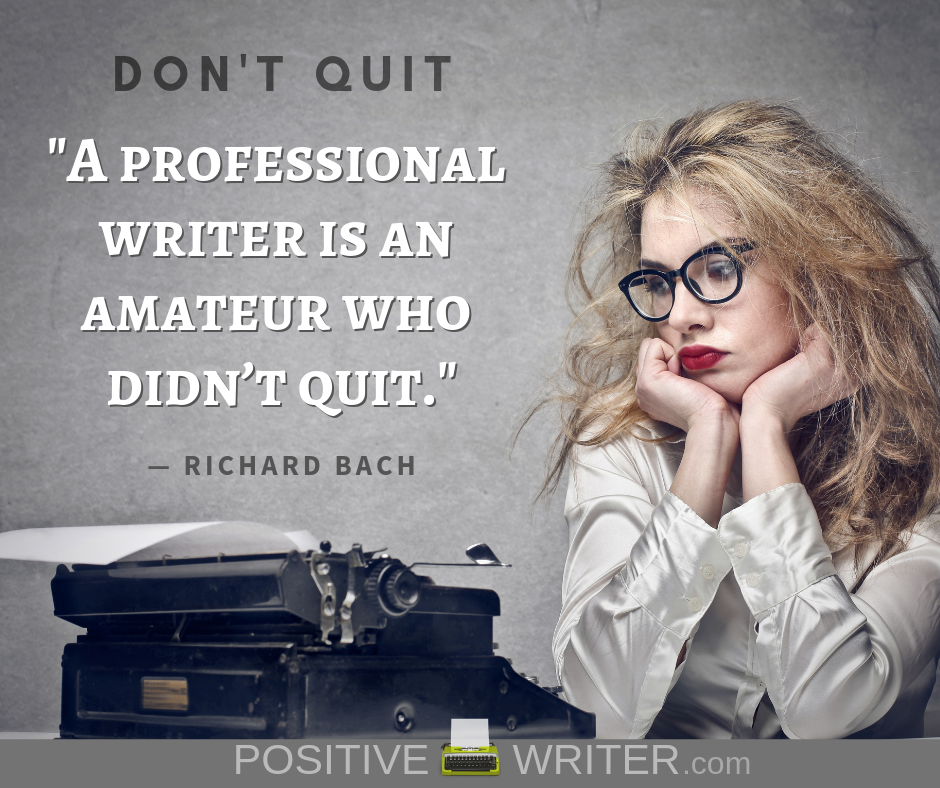
A professional writer is an amateur who didn't quit. ―Richard Bach Click To Tweet

I write entirely to find out what I am thinking, what I am looking at, what I see and what it means. What I want and what I fear. ―Joan Didion Click To Tweet

You fail only if you stop writing. ―Ray Bradbury Click To Tweet

Writing is its own reward. ―Henry Miller Click To Tweet

There is no greater agony than bearing an untold story inside of you. ―Maya Angelou Click To Tweet

I hope you enjoyed these!

What’s your favorite quote about writing? Share it in the comments.

Newer Posts
Older Posts

writers doubt book on writing

"Bryan's book, "Writer's Doubt," Will dispel any writer's doubt! Highly Recommended!" — Warren Adler, author, "The War of the Roses".
.
Writer's Doubt is an Amazon Exclusive Release.  Please note, all links to Amazon on this site are affiliate links.

Are You A Writing Warrior? If Yes, Join Us Now!

Hello! I'm Bryan Hutchinson, you might know me as the author of the bestselling book, "Writer's Doubt." On Positive Writer I help writers and bloggers do what they were born to do: Write and get attention! I'd love to keep you up to date and share my best tips with you:

Like Positive Writer on Facebook

SuperWebTricks Loading...

Become A Better Writer

Ready to improve your writing and your life?

Join The Art of Positive Journaling!


“I’m a fan!” —Jeff Goins, author of Real Artists Don’t Starve


  • Facebook
  • Twitter
  • Google +
  • Pinterest
  • RSS

Copyright © Bryan Hutchinson


Back To Top